Skip to content
↓ Download PDF (EN)
MenagerieFashion film, 2026

Menagerie

A fashion film about the voice that tells a woman who to become

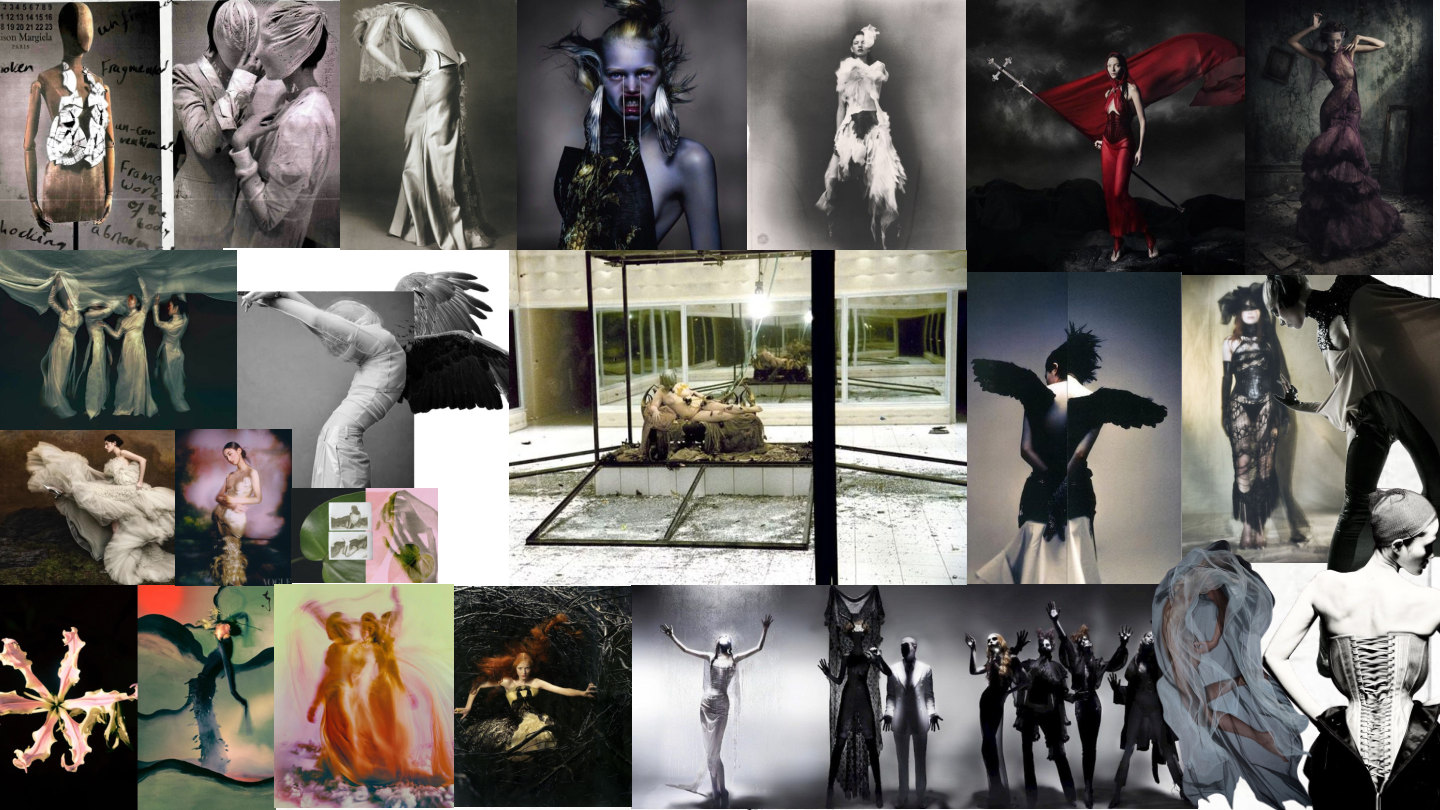
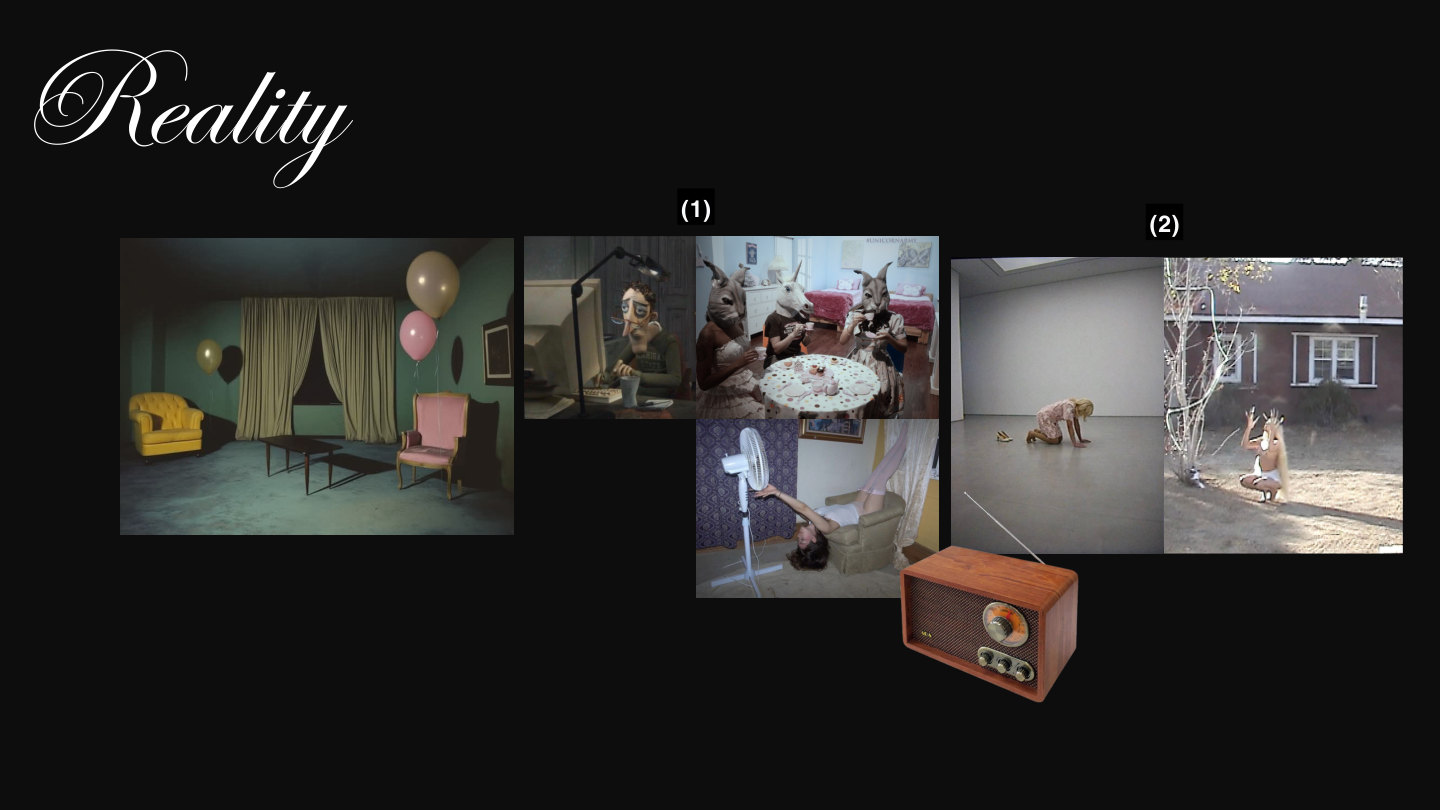
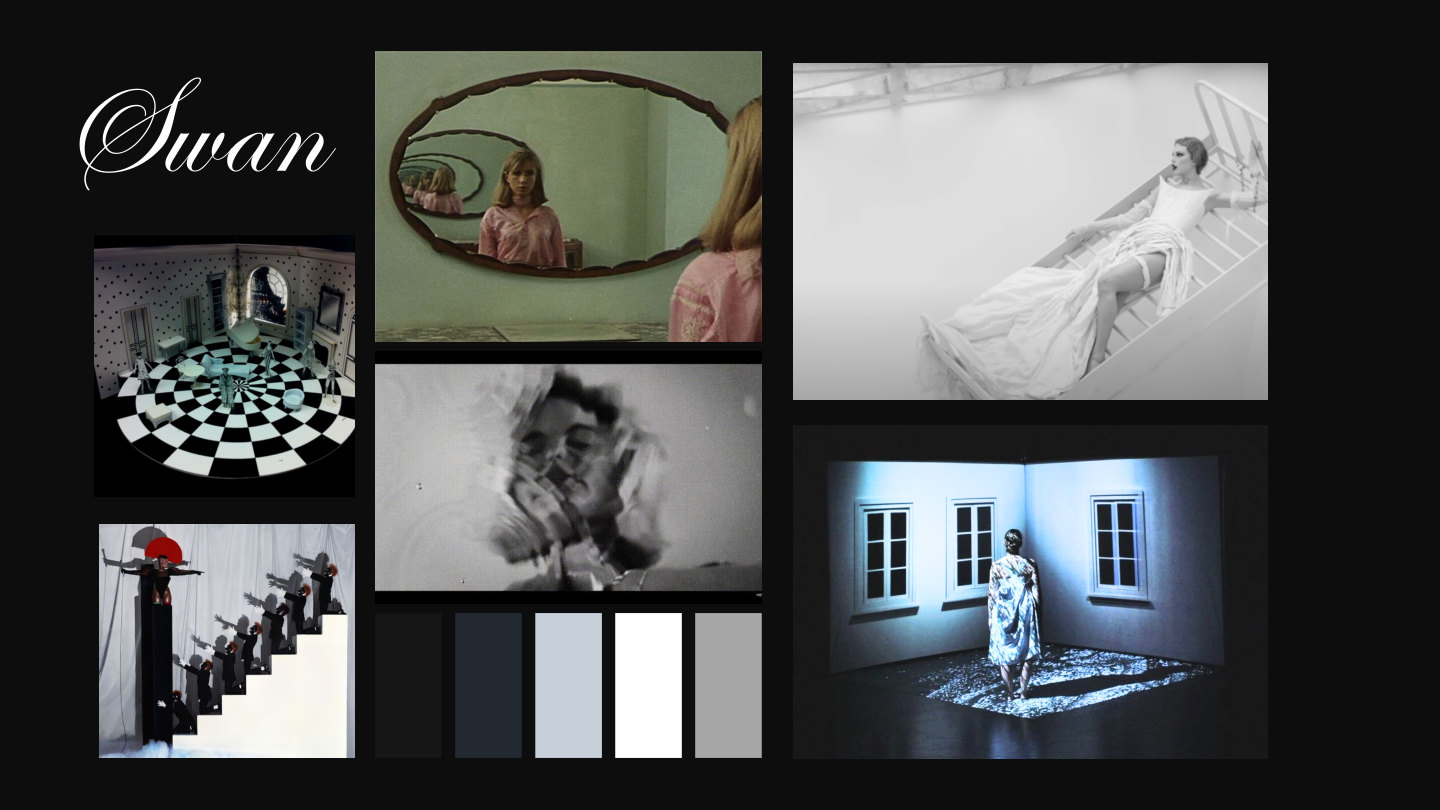
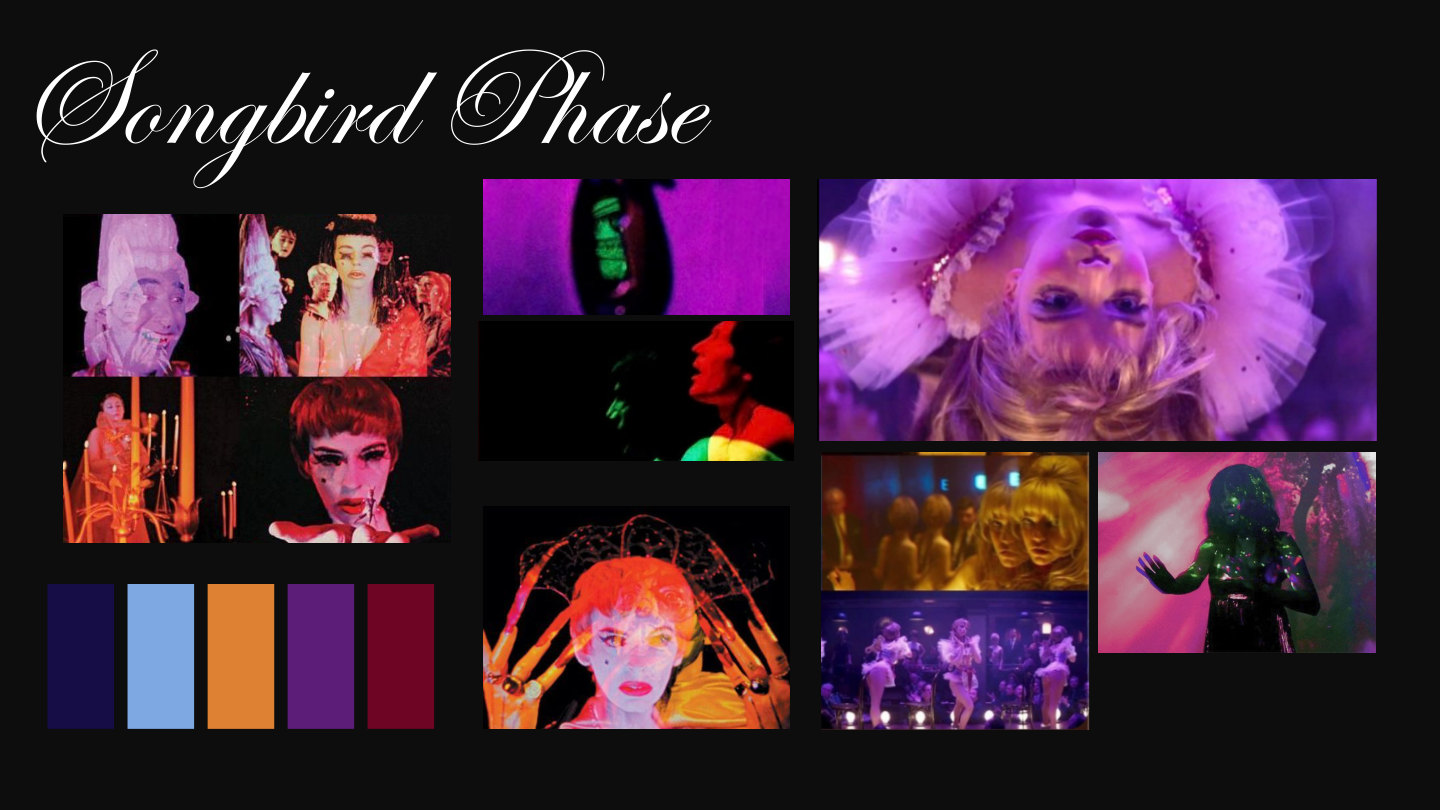
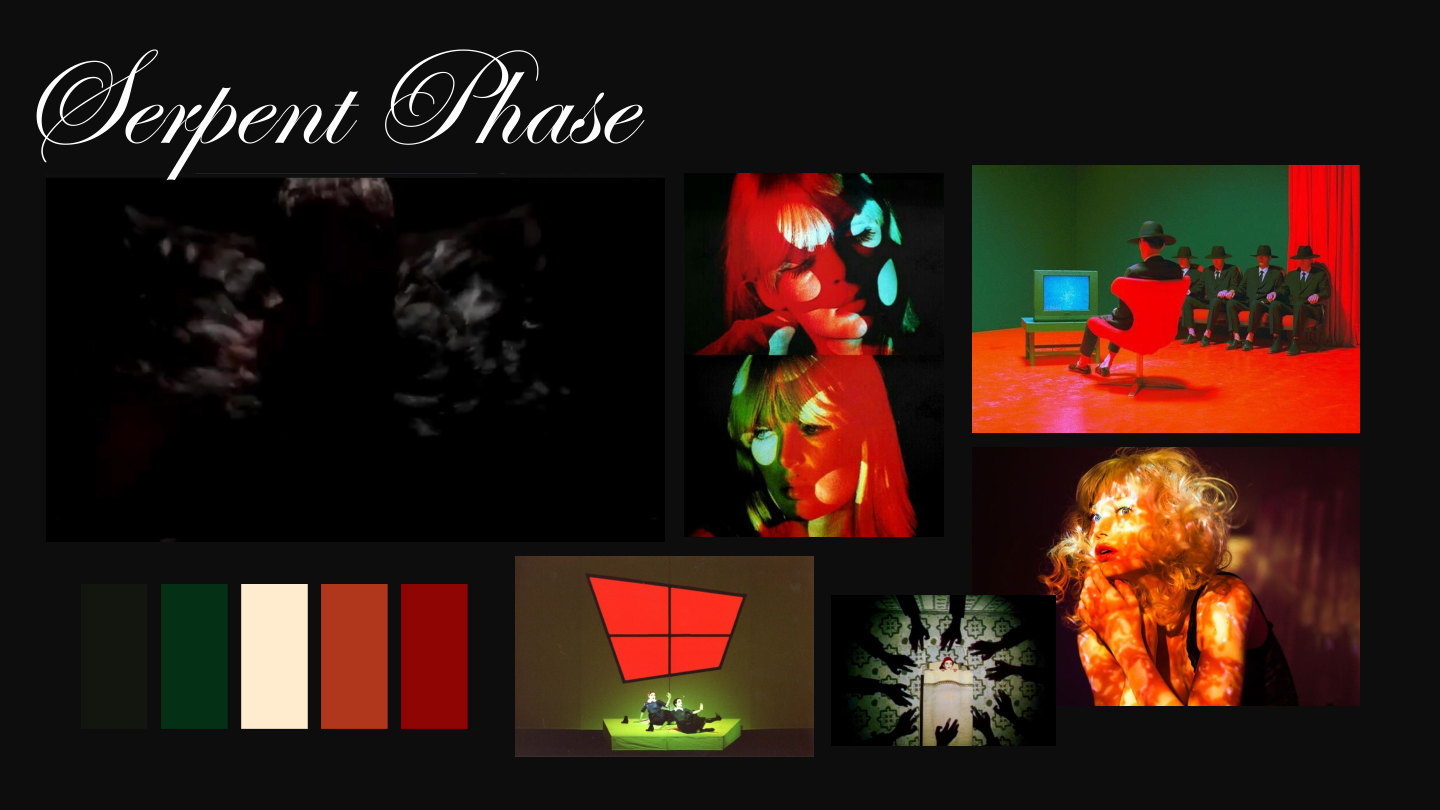
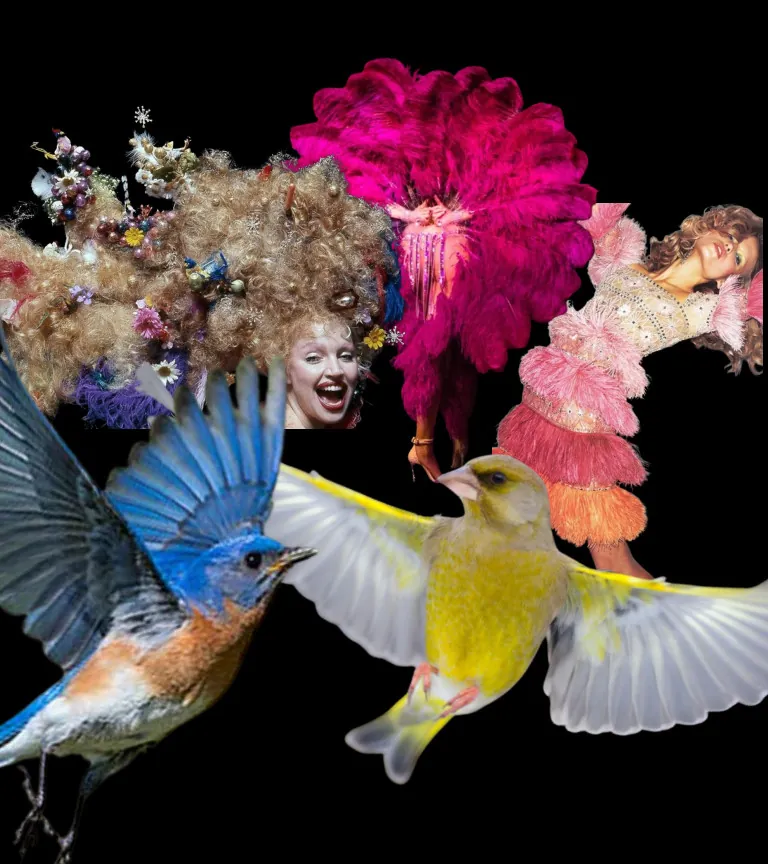
Reference images from the treatment. Work by other artists, not Menagerie footage.

Who gets to define what a woman should become?

An undefined Specimen falls asleep carrying doubts about who she should become. In her dream, three manufactured ideals of femininity rebuild themselves around her. As the dream turns lucid, she begins to see that the authoritative voice guiding her was never reality. It was a voice she had learned to obey.

Length
3 to 5 minutes. The production plan aims for about 3.
Genre
Psychological drama, surrealist
Core character
Specimen 04
Shoot
Monday 16 November 2026 at Panorama Studio, and Monday 23 November at Umi's house
Delivery
No date set yet. The media team's first draft of the edit is due Monday 30 November

From the director's film treatment, version 6, 6 October 2026

01 Story

The story

From waking life into a dream, and back to a room that is not quite real.

Specimen 04 lives an ordinary waking life, undefined and colourless. Daily pressures leave little room to ask who she is. Fleeting doubts and comparisons with other ideals keep getting pushed aside.

When she falls asleep, familiar pieces of her life rebuild themselves into a dream. Objects stay recognisable, but their size, colour and place are slightly wrong. She moves through three dream worlds shaped by the Swan, the Songbird and the Serpent, three ideals of femininity she has watched and measured herself against.

As the errors pile up, she realises she is dreaming. Once she knows, the worlds start to respond to her, but knowing does not give her control.

She seems to wake. The room is familiar again, until the same guiding male voice carries on. She follows it and finds that the authority beside her all through the dream is a recorded hypnotic narration. The film does not give her a fixed identity. What changes is her relationship to the voice that has been defining her.

The internalised menagerie

Menagerie treats the cage as a set of expectations she carries inside her, not a structure built by an outside villain. Specimen 04 has not yet formed a fixed identity. In waking life, routine and survival keep pushing her questions down. The dream is where those buried comparisons, fears and expectations come back as images, spaces and voices.

Treatment p. 7

Master story

The three women in the dream are not universal definitions of femininity. They are exaggerated cultural types, purity, visibility and sexual desirability, that have been styled, sold and made easy to consume. Specimen 04 compares her undefined self with identities that already look readable and rewarded. The film ends at the moment she begins to step away from the structures that taught her how femininity should be seen, valued and consumed.

Treatment p. 9
Treatment p. 6

02 Storyline

The storyline

The film scene by scene, as the producer told it on 10 October from script v2.

A tired young woman falls asleep to a voice on the radio and dreams her way through three ideals of femininity. She learns from the first, performs with the second and becomes the third. She wakes and switches the voice off, but it keeps talking inside her head.

One voice

A calm male voice comes out of S04's radio. It tells her what to do, what she lacks and what she should be. In the dream, the same voice comes out of the mouths of three faceless figures: her mother, her coach and society. At the end it comes from inside her own ear. The film does not ask who owns the voice. It shows that she has learned to obey it.

Three steps deeper

Each world asks a little more of her.

  • The Swan asks her to study: copy the steps until she is approved. The goal is to belong.
  • The Songbird asks her to perform: hold the ball, smile and be watched. The goal is to be seen.
  • The Serpent asks her to become the thing itself. The goal is to be desired.

Two refusals, then too late

S04 stops in the Swan's world and stops again in the Songbird's world. Each time she pays for it: the figures shake their heads, and the audience looks away. In the Serpent's world she does not get to choose. When the curtain opens, she is already the Serpent. The cage was never only around the other women. She carried it with her.

Each world has its own cage

The Swan's cage is a mirror. The Songbird's cage is light and shadow, the ring of the spotlight and the shadow of the audience. The Serpent's cage is hands.

Times are positions in a cut of about 4:38.

  1. Reality

    0:00 to 0:49

    Shots 1–11

    Night, in a small room. S04 sits at her desk and types, deletes and types again. We see her from behind, alone in the warm light of the desk lamp. The screen lights her face, and she reads without taking anything in. Her fingers repeat the same pattern like a machine. Her face is empty.

    She reaches over and turns on the radio. A calm male voice starts to talk: advice, judgement and pressure, without a name. Her thoughts answer it in flashes. A foot misses a step. A stone hangs on a fraying string. At a table, two hands give quickly and hers gives slowly. A pen taps an unticked box. The clock nears midnight. A money counter runs backwards. A small ball is pressed flat.

    Her eyes fix on nothing. Her eyelids fall slowly, and the voice goes muffled, as if heard through water. Her head sinks onto the papers on her desk. Black.

  2. Into the dream

    0:49 to 1:00

    Shots 12–15

    Bare feet in the dark. One careful step, then a quicker one, then a third, as if something pulls her forward. She comes out at the edge of a white space and stops. If Giselle agrees, her radio lies on the white floor, still talking quietly. It is the first thing in the dream that should not be there.

  3. The Swan

    1:00 to 1:59

    Shots 16–29

    In the white space stands an empty mirror frame with no glass. S04 walks up to it. On the other side the Swan walks toward her, and they stop face to face, like a woman and her reflection.

    S04 blinks. In the dark she sees three faceless figures, her mother, her coach and society, talking without pause in the radio's voice. The Swan hears them too and stands still to receive them.

    The Swan begins a dance. S04 copies her a beat late. She stays one step behind, glances toward the figures and hurries to catch up. The frame opens into an endless corridor of mirrors. In every reflection the Swan is one step ahead, and S04 almost matches her. When she does, the three figures nod one after another, and she dances on at once, as if the nod were the reward.

    Then her hands keep dancing after she has slowed down. The steps have become a reflex. She grabs one wrist with the other hand and reaches out to touch the glass. Her hand goes through the empty frame. On the other side the Swan keeps dancing and does not copy her. A reflection that does not follow you cannot be real. S04 knows she is dreaming.

    The figures shake their heads. She almost lifts her arms back into the first step, and stops. She lowers them. For the first time she chooses not to go on, knowing she will lose their approval. She steps back from the frame and walks away while the Swan keeps dancing behind her.

  4. The Songbird

    1:59 to 3:12

    Shots 30–42

    A ring of light appears on the floor ahead. S04 stops at its edge, then takes three slow steps into it. On a small stage the Songbird performs with a large ball balanced on one forearm and a small ball on the other, smiling. A giant Audience Head turns toward her as she performs harder.

    The small ball slips. S04 catches it, and the Audience Head turns to look at her. She feels the look and tries to keep the ball up. She climbs onto the stage beside the Songbird. The two of them perform side by side, and the Songbird works harder to win the head back. Her ball grows. Her arm begins to shake, but the smile stays. The Audience Head grows too and changes colour, and its shadow falls across the Songbird. Her smile trembles at the corners.

    S04 looks at the small ball in her hand and lets it go still. The Songbird signals to her: keep going. S04 lifts the ball a little, then stops, and the Songbird turns back to her own act, faster than before. S04 puts the ball on the floor, steps down and backs out of the light. The Audience Head looks away from her and returns to the Songbird.

    Something unseen pulls the Songbird backwards, out of the light. She folds and drops to her knees, still smiling and still trying to lift the ball. From the dark, S04 watches. She almost steps back in, but she stops and closes her eyes. When she opens them, a curtain sweeps across in front of her until there is nothing else to see.
  5. The Serpent

    3:12 to 4:08

    Shots 43–54

    The camera moves slowly along a curved curtain in a dark, closed space. Behind it a woman's silhouette strikes a slow, seductive pose. Shadow hands on the curtain clap for her. She takes a bolder pose, and the hands stop clapping and begin to reach. A third pose, the boldest, and the hands cover the curtain as if to take hold of her.

    The curtain opens. The woman standing there, in the third pose, is S04, dressed as the Serpent. She looks down at her body and her hands in someone else's clothes and understands. In the Swan's world she noticed in time. Now she is too late.

    A white hand, a real one, lunges out of nowhere straight at her. Its shadow covers her. She freezes. Her shoulders rise and her arms pull in, and the body that was on display becomes a body defending itself. As the hand reaches for her throat, she shuts her eyes hard. Black.

  6. False awakening

    4:08 to 4:38

    Shots 55–61

    S04 jerks up from her desk. The room is as it was, and the radio is still talking. Perhaps a white feather lies on the keyboard. She turns the dial to off. Silence. She turns away from the chair, and the dead radio comes into focus.

    Then the voice starts again, from inside her ear, harsher and full of static. She covers her ears and stares at the radio, which is switched off. The voice no longer needs it. She shuts her eyes tight. Over black, the voice says one more line, then stops.

What the audience should take away

The film does not say whether S04 is awake, or who she will become. The master map ends on "WAKE ?" and so does the film. What has changed is that she has found the machine the voice came from and switched it off. The voice is still there, but now she knows it was learned. It was never the truth about her.

Still open

These affect the story, so Giselle should decide them before the storyboard is redrawn. The full list is in the shot list.

  • Whether S04's Serpent look is a second costume made to fit her.
  • Whether the Audience Head is built or projected.
  • Whether to keep the radio on the white floor and the feather on the keyboard.
  • Who records the voice.
  • The narrative page in the treatment still says S04 follows the voice to a recording. This storyline instead has her switch off the radio and hear the voice continue inside her. The treatment text should change to match.

Questions for Giselle

Points in the storyline that may not hold together yet, from the producer’s read on 10 October.

Main questions

  1. 01

    Why does S04 become the Serpent?

    She refuses twice and then it is too late, but refusing usually leads to freedom. Nothing she does between the Songbird and the Serpent explains the change yet.

  2. 02

    Where is the voice in the Songbird and Serpent worlds?

    In the Swan world the three figures speak with the radio’s voice. After that the voice is gone until the ending, and the Audience Head and the hands are silent. If the voice is missing for two worlds, the idea that holds the film together breaks in the middle.

  3. 03

    What does the voice say, and who writes it?

    No lines are written yet. The last line at shot 61 may be the most important line in the film. The language and whether it has subtitles also need a decision.

  4. 04

    What should the audience feel at the end?

    The storyline says S04 now knows the voice was learned. On screen she covers her ears and shuts her eyes while the voice goes on, which most viewers will read as defeat. Choose between hope, defeat and a question, and decide what her face does at shot 60 to show it.

The Swan

  1. 05

    Is the mirror glass or an empty frame?

    If the audience can see that the frame is empty, her hand going through it is no surprise. The corridor of mirrors and the infinity mirror also need real mirrors.

  2. 06

    How does S04 learn she is dreaming?

    The Swan never copies her, even at the start, so a reflection that does not follow her is nothing new at shot 26.

  3. 07

    Where are the three figures?

    They appear in the dark when she blinks, but later they nod while she dances. Are they in the white space with her or only in her head, and can the Swan see them?

  4. 08

    What happens to the Swan?

    The Songbird collapses and the Serpent is attacked, but the Swan only keeps dancing. If being trapped forever is her fate, it may need to read more clearly.

The Songbird

  1. 09

    What do the two balls stand for?

    The reality scene shows a small ball pressed flat, which links to the Songbird, but neither ball has a stated meaning. Is the small ball S04’s chance to be seen, and the big ball the weight of performing?

  2. 10

    What pulls the Songbird out of the light?

    An unseen force at shot 40 can look random. Is it the Audience Head, the voice or the shadow?

  3. 11

    What does the Audience Head’s change of colour mean?

    It changes colour at shot 36, but the story does not say what the colour means.

  4. 12

    Does the Songbird sing?

    Her name suggests a song, and the script has none. Each world also needs a decision on what it sounds like.

The Serpent

  1. 13

    Is the Serpent meant to appear only as a silhouette?

    The Swan and the Songbird appear in person. The Serpent is a shape behind the curtain and then turns out to be S04. Was it always S04, or did she take the Serpent’s place?

  2. 14

    Whose hands are they?

    First shadow hands clap, then they reach, then a real white hand attacks her. Are they the audience, the voice, or men in general?

  3. 15

    Is the Serpent look on screen long enough?

    It is a silhouette until shot 48, and after that S04 spends most of her shots frozen and covering herself. Has the designer agreed to this?

Reality and structure

  1. 16

    Does each flash image in shot 7 lead to a world?

    The missed step links to the Swan and the flattened ball to the Songbird. The stone on a string, the money counter, the unticked box and the two hands at the table link to nothing yet, and the Serpent has no flash. Which world does each one belong to?

  2. 17

    What is S04 working on?

    She types and deletes, a box stays unticked and a money counter runs backwards. Knowing whether it is a job application, an essay or a debt gives the voice something specific to press on.

  3. 18

    Does S04 stay lucid after the Swan?

    She learns she is dreaming at shot 26. If she still knows in the Songbird world, why is she pulled in? If she forgets, why?

  4. 19

    What moves her from one world to the next?

    A ring of light appears, and later a curtain closes. Is something pulling her each time, such as the voice, a sound or the radio?

  5. 20

    How long can the film be?

    The cut is about 4:38. Earlier plans said 3:00, and the director’s spoken plan on 4 October was 180 seconds. The first fashion look appears at 1:00, after a 49-second reality scene.

Smaller points

  1. 21

    Is the mother speaking with a male voice intended?

  2. 22

    If the feather stays on the keyboard at shot 55, it suggests the dream was real. Does that work against the idea that the voice was learned?

  3. 23

    The radio on the white floor at shot 15 appears only once. Does it come back later?

  4. 24

    Will the camera show S04’s white feather, coloured feather and lace tie clearly in the reality scene?

Producer storyline, 10 October 2026, from script v2. It replaces the 4 October storyline. The treatment pages below are older and may disagree.

03 Phases

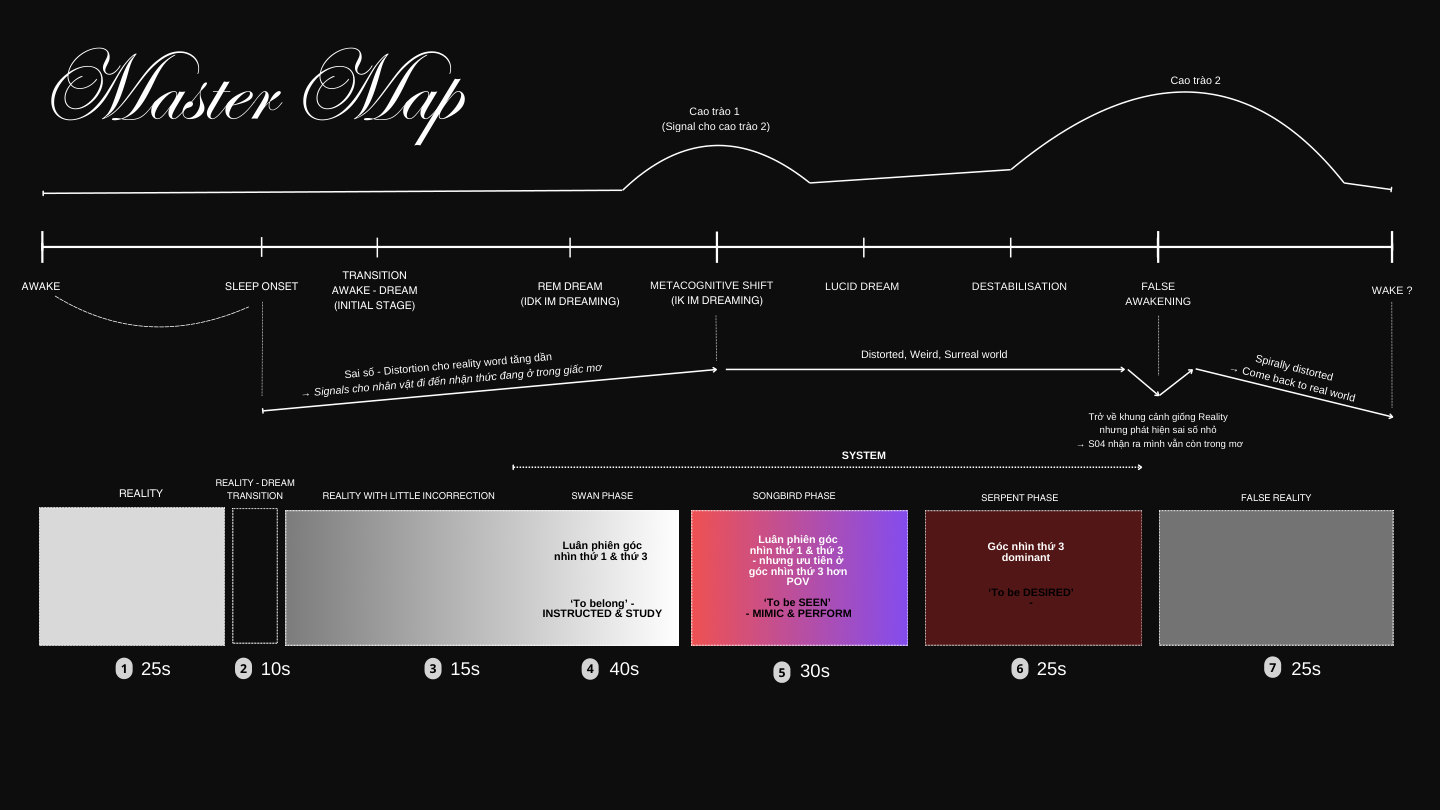
The master map

Seven phases, from awake to a false awakening.

  1. 01

    Reality

    Awake

    25 seconds

    Her ordinary room, tight and repetitive. Nothing in it is wrong yet.

    Third person

  2. 02

    Falling asleep

    Sleep onset

    10 seconds

    The move from waking into the dream.

    A held, nearly abstract frame

  3. 03

    Reality with small errors

    The dream begins, but she does not know it

    15 seconds

    The same room with small errors that grow. Each one is a hint that she is dreaming.

    Third person

  4. 04

    Swan

    Dreaming, unaware

    40 seconds

    To belong. She is instructed and studies the ideal. The first peak of the film signals the second.

    First and third person in turn

  5. 05

    Songbird

    She realises she is dreaming

    30 seconds

    To be seen. She copies the ideal and performs it.

    First and third person in turn, mostly third

  6. 06

    Serpent

    Lucid, then the dream breaks apart

    25 seconds

    To be desired. The world is at its most distorted, and the second, larger peak arrives.

    Third person

  7. 07

    False reality

    She seems to wake

    25 seconds

    Back in a room like reality, but with a small error. She sees she is still dreaming, and the voice turns out to be a recording.

    Third person

These seven timings add up to 170 seconds. The director's spoken plan on 4 October used 180 seconds, so the split may still change. The Swan, Songbird and Serpent phases together form what the map calls the system.

Treatment p. 11, p. 12

04 Look and cages

Mood, viewpoint and the three cages

How reality and the dream look different, and what traps her in each world.

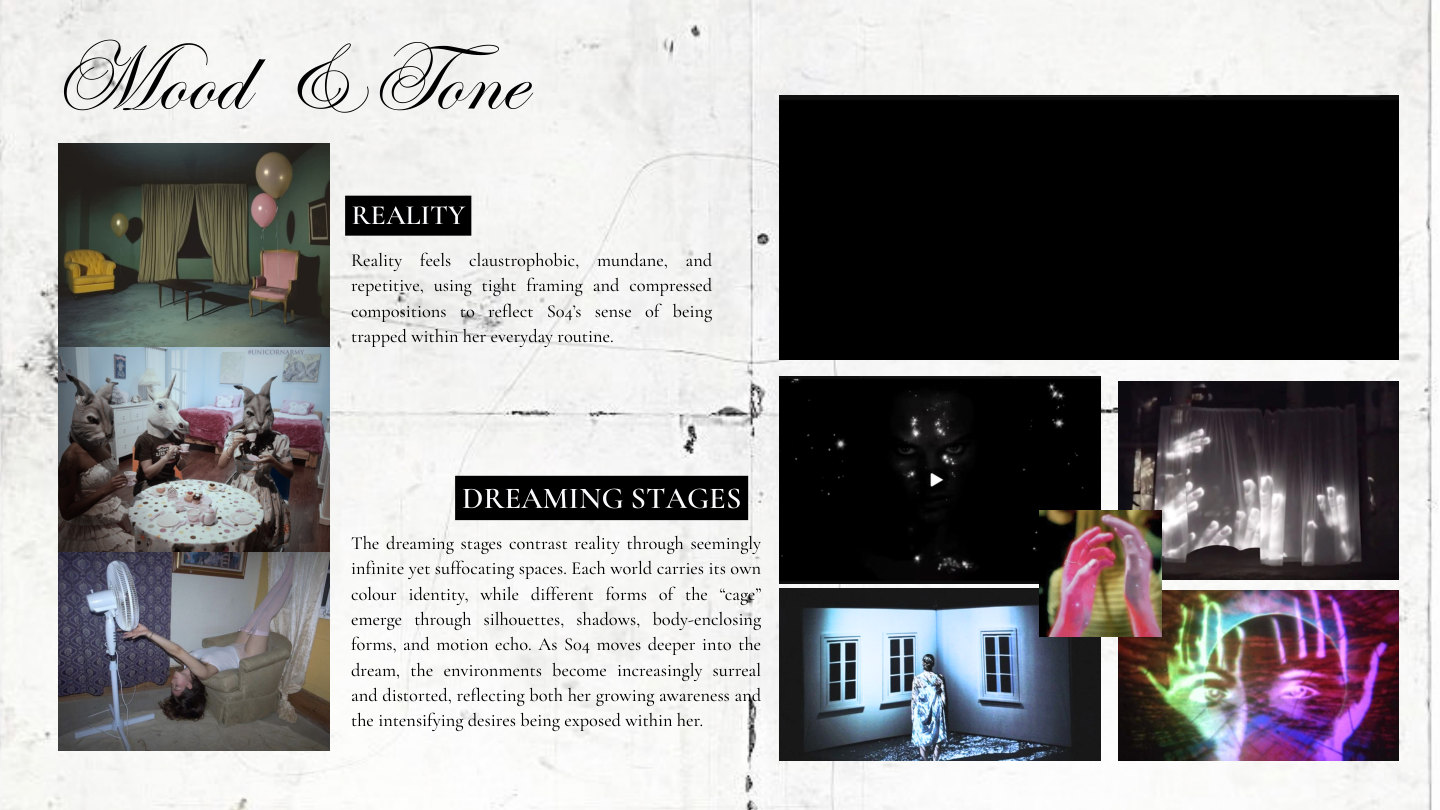
Mood and tone

Reality

Closed in, ordinary and repetitive. Tight framing and packed compositions show how trapped she is in her routine.

The dream

Spaces that feel endless but still suffocate. Each world has its own colour. The cage takes a different form in each, through silhouettes, shadows, shapes that enclose the body, and echoes of movement. The deeper she goes, the stranger and more distorted the worlds become.

Treatment p. 15

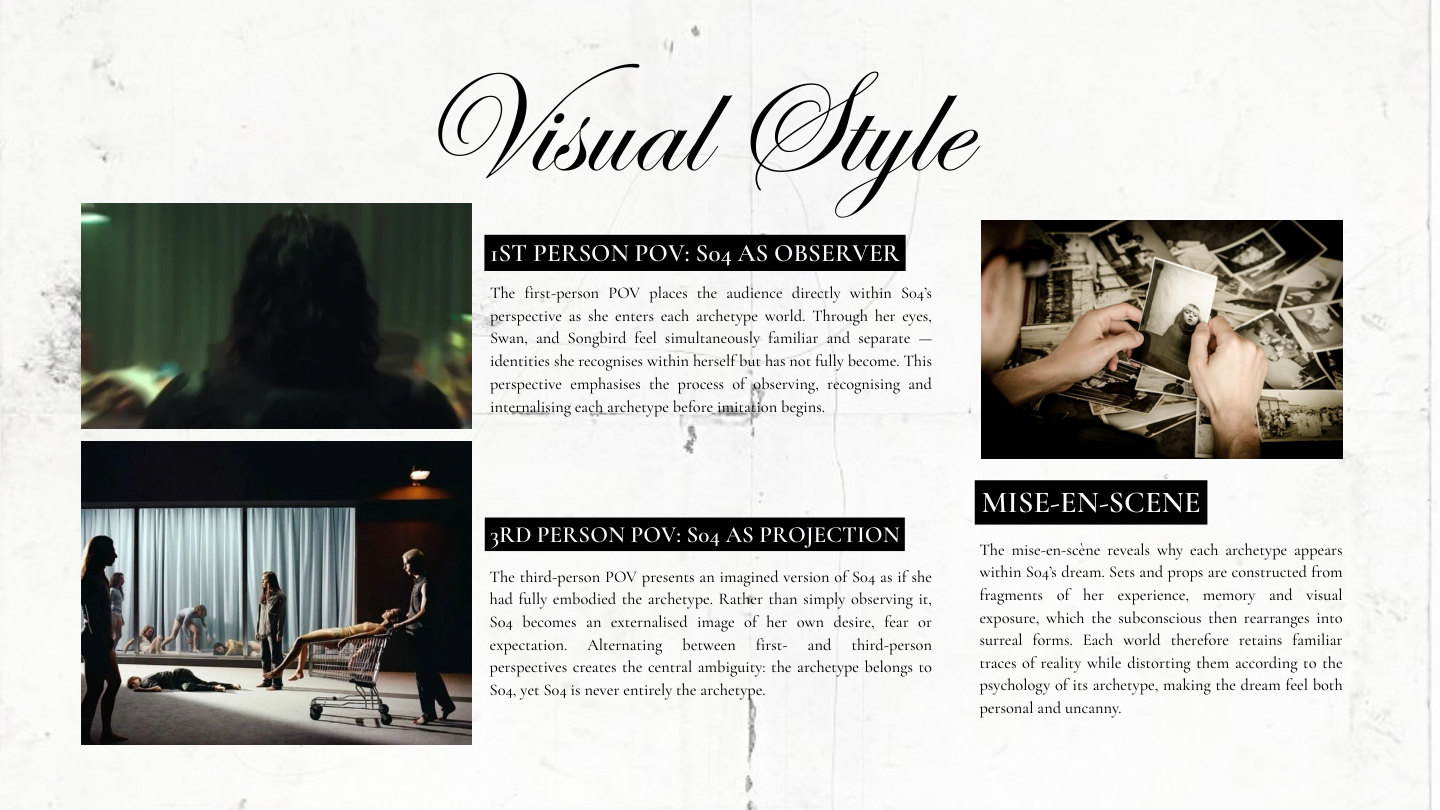
Point of view

First person: Specimen 04 watches

The audience sees through her eyes as she enters each world. The Swan and the Songbird feel familiar and separate at once: identities she sees in herself but has not become.

Third person: Specimen 04 as a projection

An imagined version of her, as if she had fully become the ideal. She turns into an outside image of her own desire, fear or expectation. Switching between the two views keeps the film's central doubt: the ideal belongs to her, yet she is never fully the ideal.

Sets made from her life

Every set and prop is built from pieces of her experience, memory and what she has seen, rearranged by the dream. Each world keeps traces of her real room, bent to fit its ideal, so the dream feels personal and uncanny.

Treatment p. 16

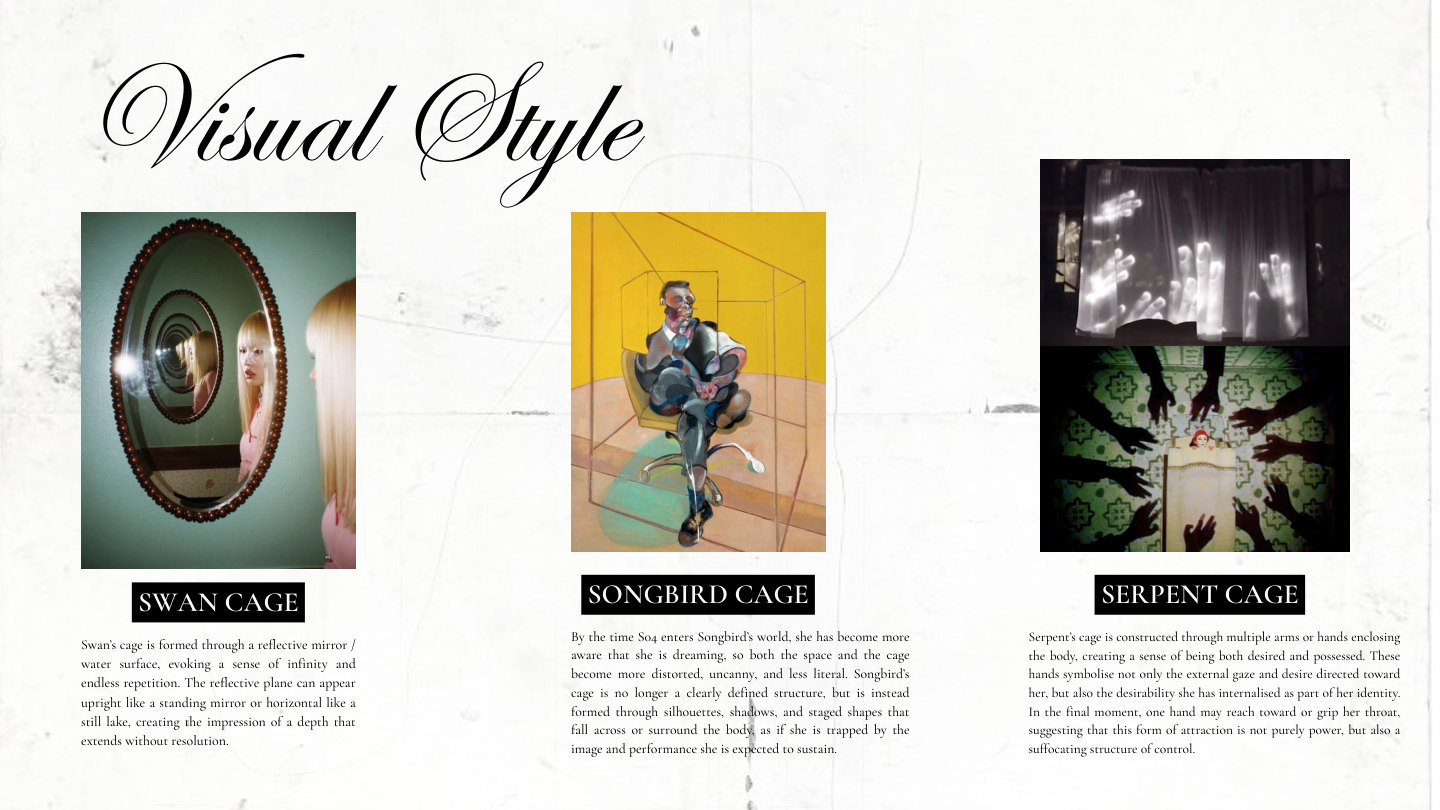
The cages

The Swan's cage

A mirror or a still water surface that repeats without end. It can stand upright like a mirror or lie flat like a lake, giving a depth that never resolves.

The Songbird's cage

By now she half knows she is dreaming, so the cage is less literal. It is made of silhouettes, shadows and staged shapes that fall across her, as if the image she must keep up is what traps her.

The Serpent's cage

Many arms or hands closing around her body, so she is both desired and possessed. The hands stand for the gaze of others and the desirability she has taken in as her own. At the end one hand may reach for her throat, showing that being desired is also a structure of control.

Treatment p. 17

05 Specimens

Four specimens

Three ideals of femininity, and the woman measuring herself against them.

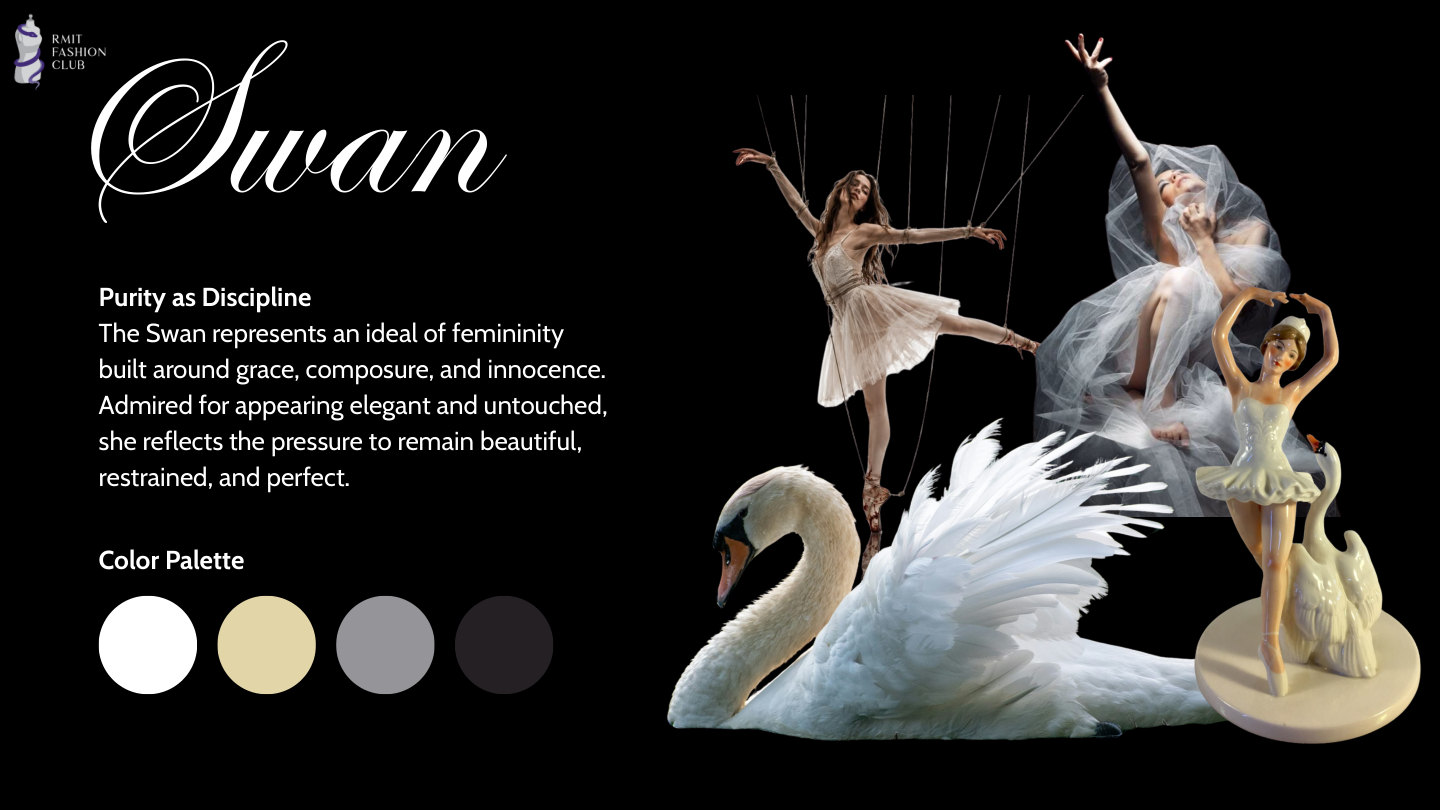
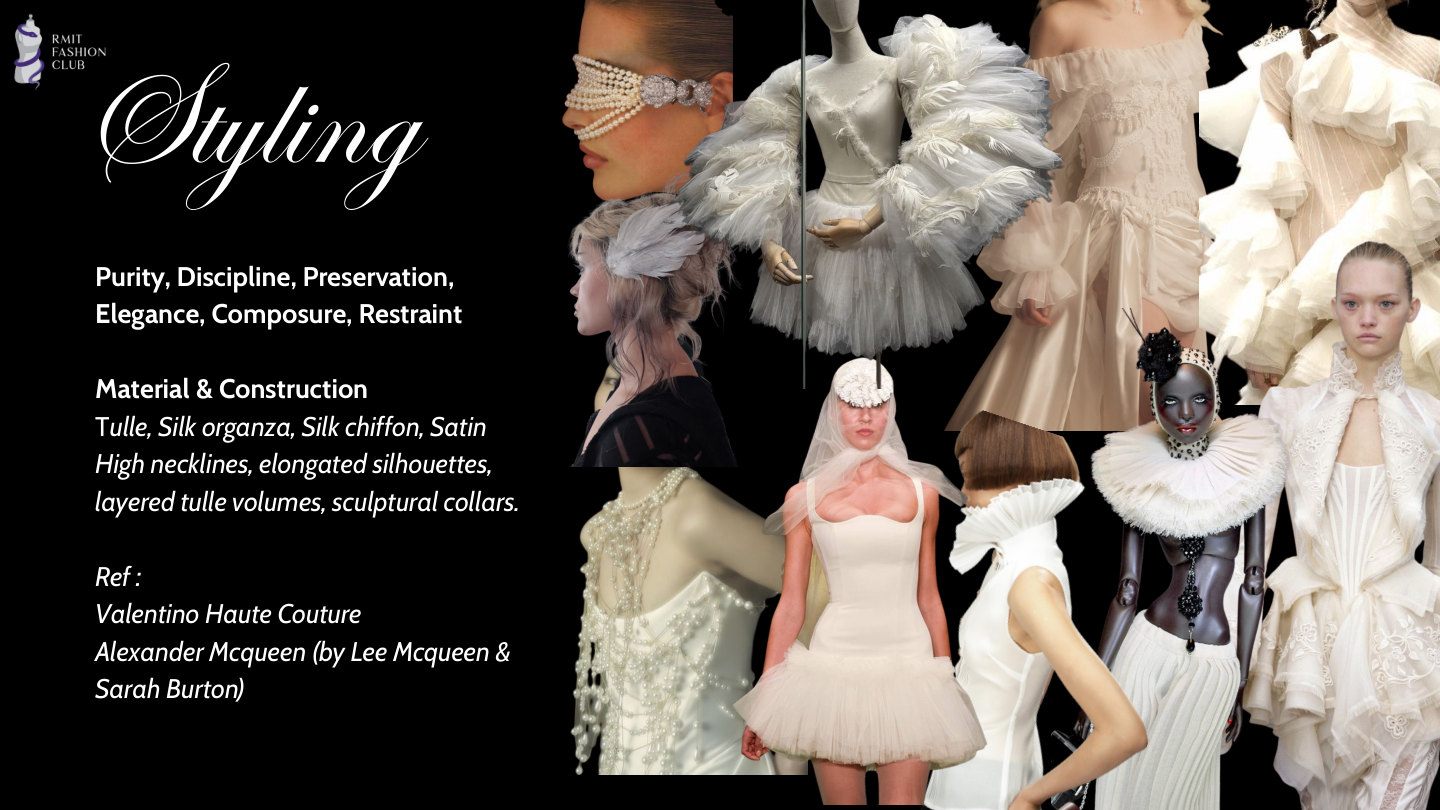
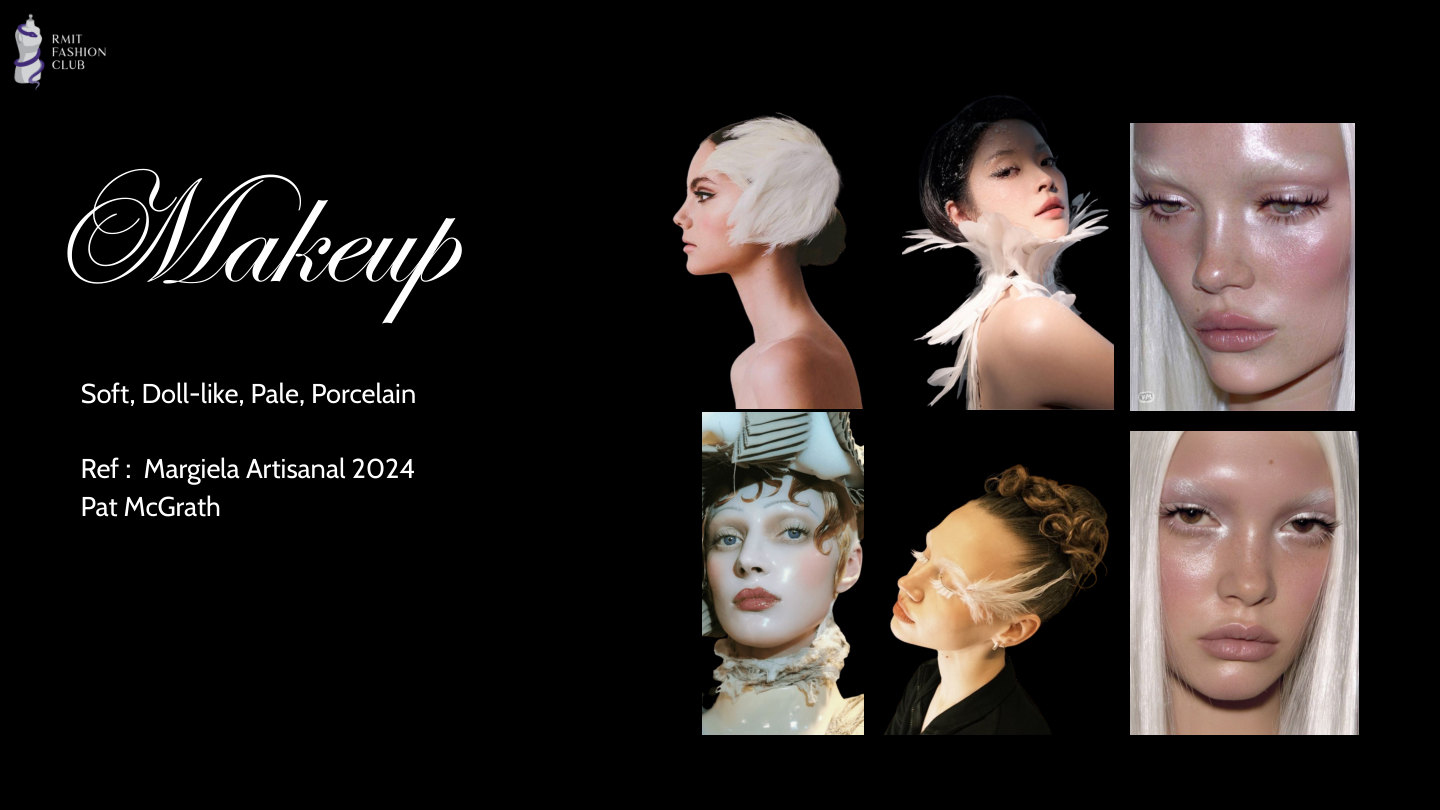
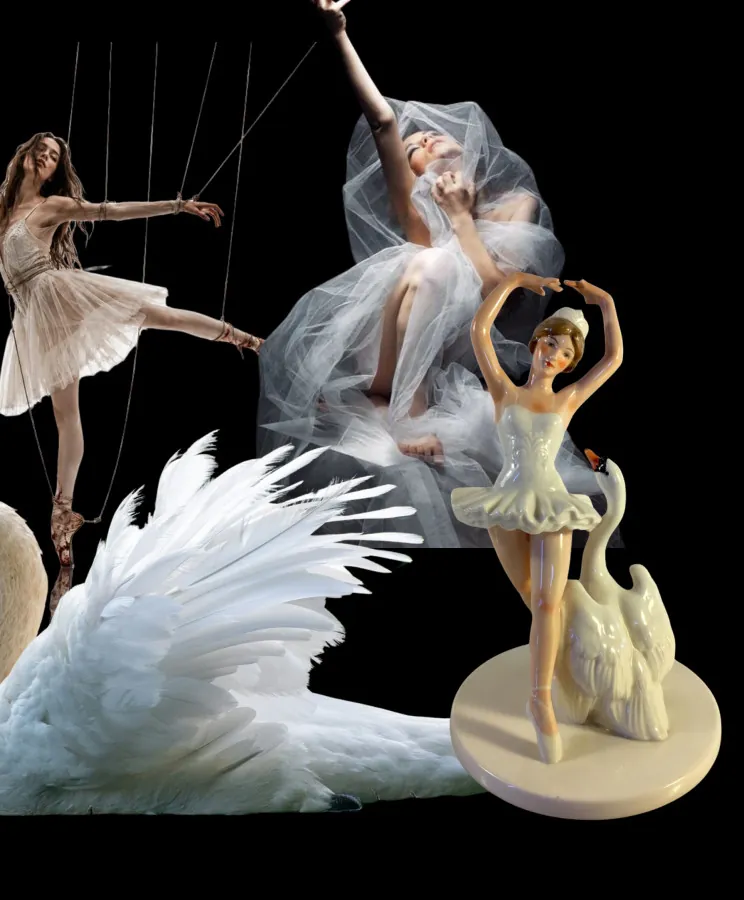
Swan reference images from the treatment
Reference images from the treatment. Work by other artists, not Menagerie footage.

Swan

Purity

Purity as discipline

The Swan is an ideal built on grace, composure and innocence. Admired for looking elegant and untouched, she carries the pressure to stay beautiful, restrained and perfect.

Keywords
Purity, discipline, preservation, elegance, composure, restraint.
Elements
Sheer fabric, feathers and pearls.
Materials
Tulle, silk organza, silk chiffon and satin.
Construction
High necklines, long silhouettes, layered tulle volumes and sculptural collars.
Makeup
Soft, doll-like, pale and porcelain.
Named references
Valentino Haute Couture; Alexander McQueen, by Lee McQueen and Sarah Burton; Maison Margiela Artisanal 2024; Pat McGrath.
In the film

Phase 4, 40 seconds. To belong: she is instructed and studies the ideal.

Treatment p. 35, p. 36, p. 37, p. 38
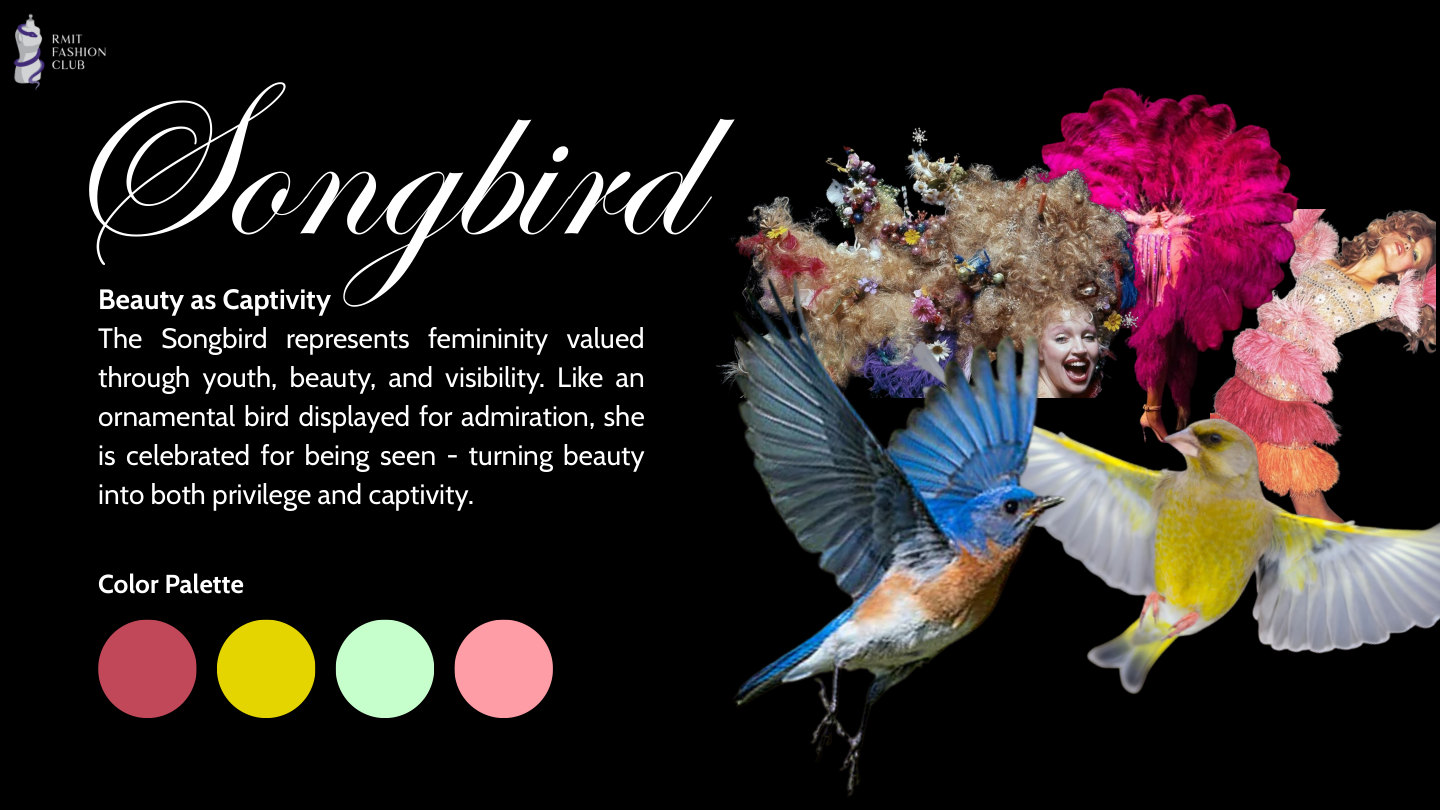
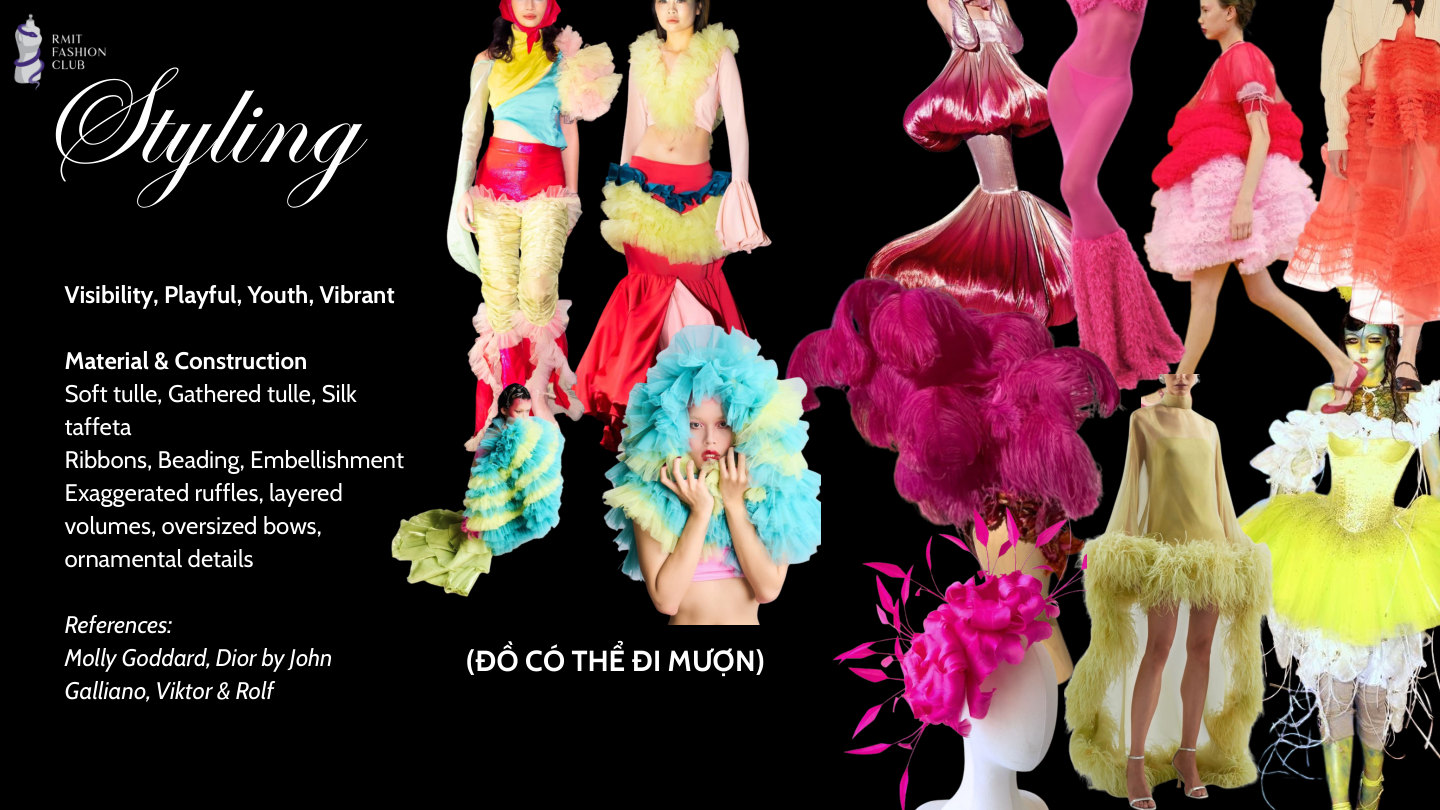
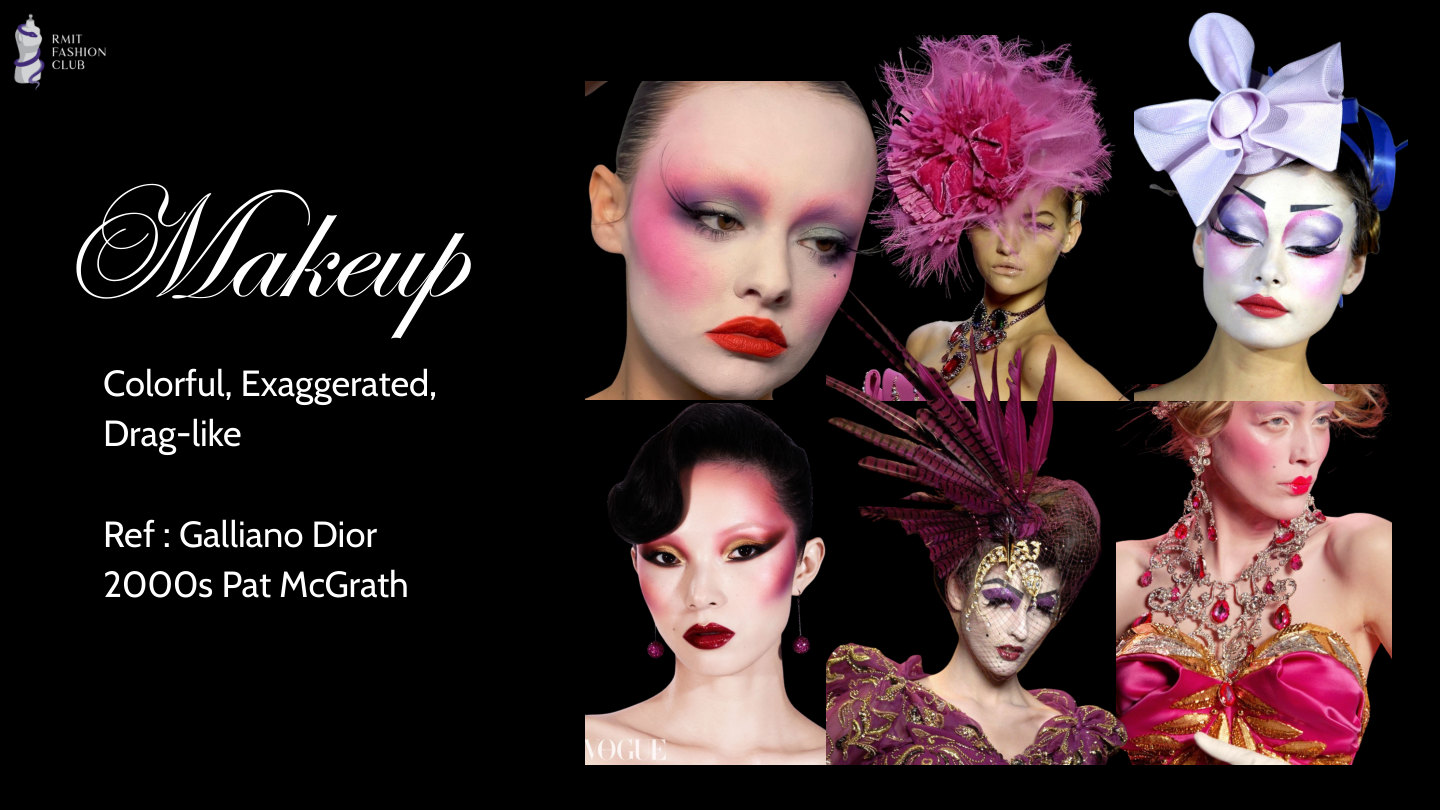
Songbird reference images from the treatment
Reference images from the treatment. Work by other artists, not Menagerie footage.

Songbird

Beauty

Beauty as captivity

The Songbird is femininity valued for youth, beauty and being seen. Like an ornamental bird kept for display, she is celebrated for being looked at, which makes beauty both a privilege and a cage.

Keywords
Visibility, playful, youth, vibrant.
Elements
Branches, boas, feathers, fur and tulle ruffles.
Materials
Soft tulle, gathered tulle and silk taffeta, with ribbons, beading and embellishment.
Construction
Exaggerated ruffles, layered volumes, oversized bows and ornamental details.
Makeup
Colourful, exaggerated and drag-like.
Named references
Molly Goddard; Dior by John Galliano; Viktor & Rolf; Galliano-era Dior in the 2000s; Pat McGrath. The treatment notes that these garments can be borrowed.
In the film

Phase 5, 30 seconds. To be seen: she copies the ideal and performs it.

Treatment p. 39, p. 40, p. 41, p. 42
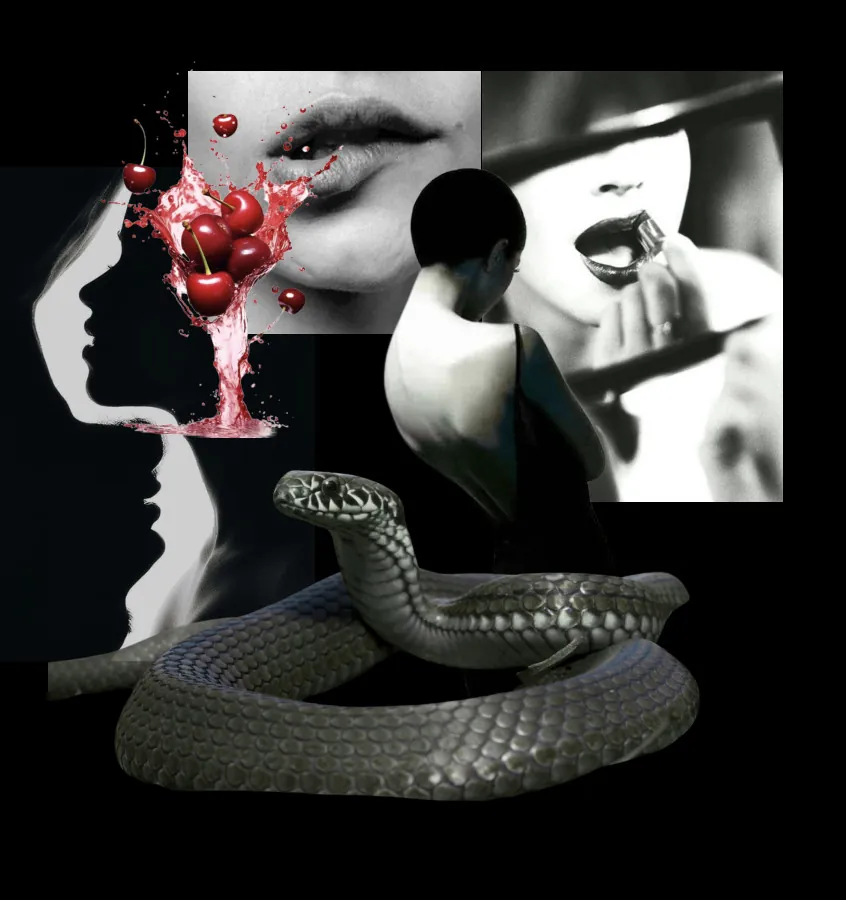
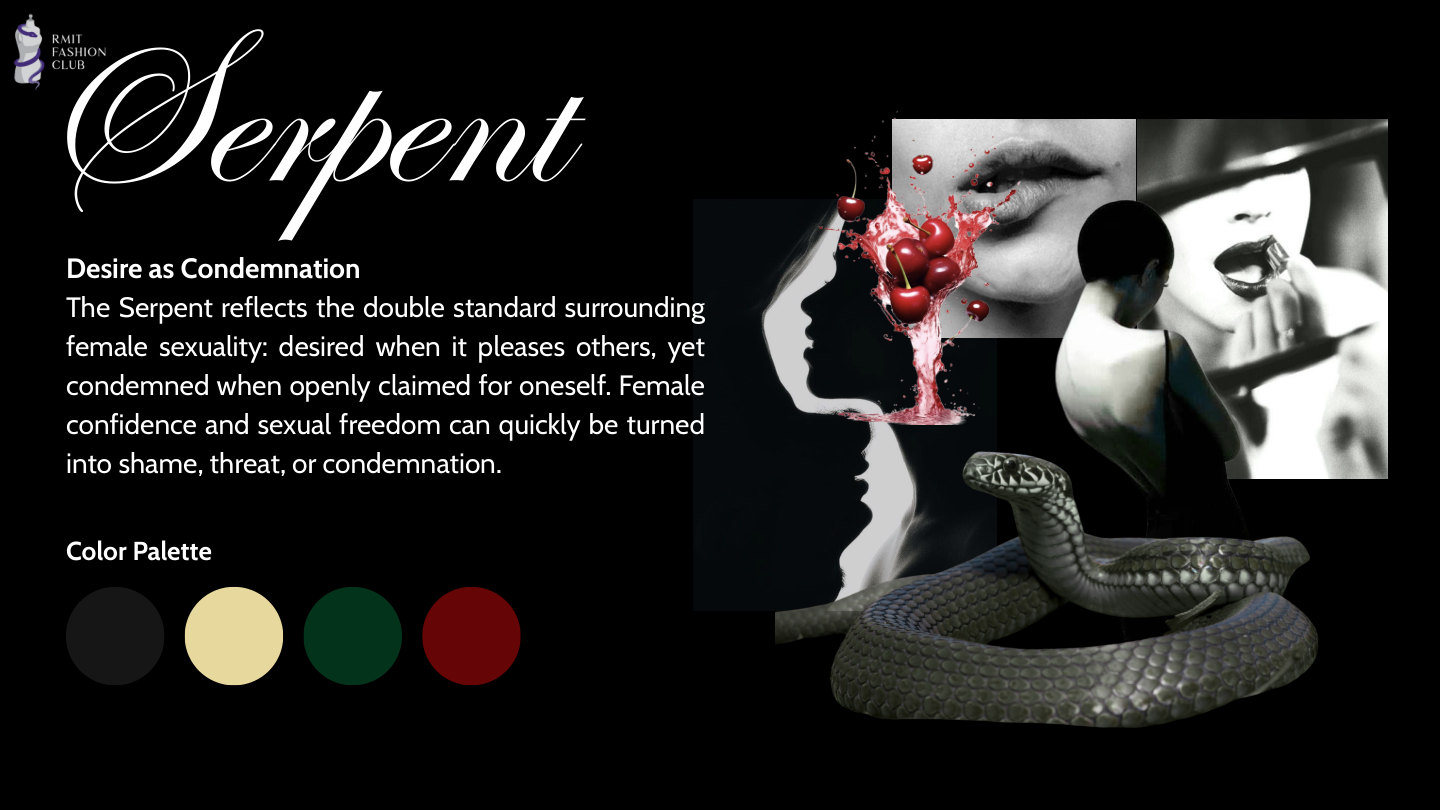
Serpent reference images from the treatment
Reference images from the treatment. Work by other artists, not Menagerie footage.

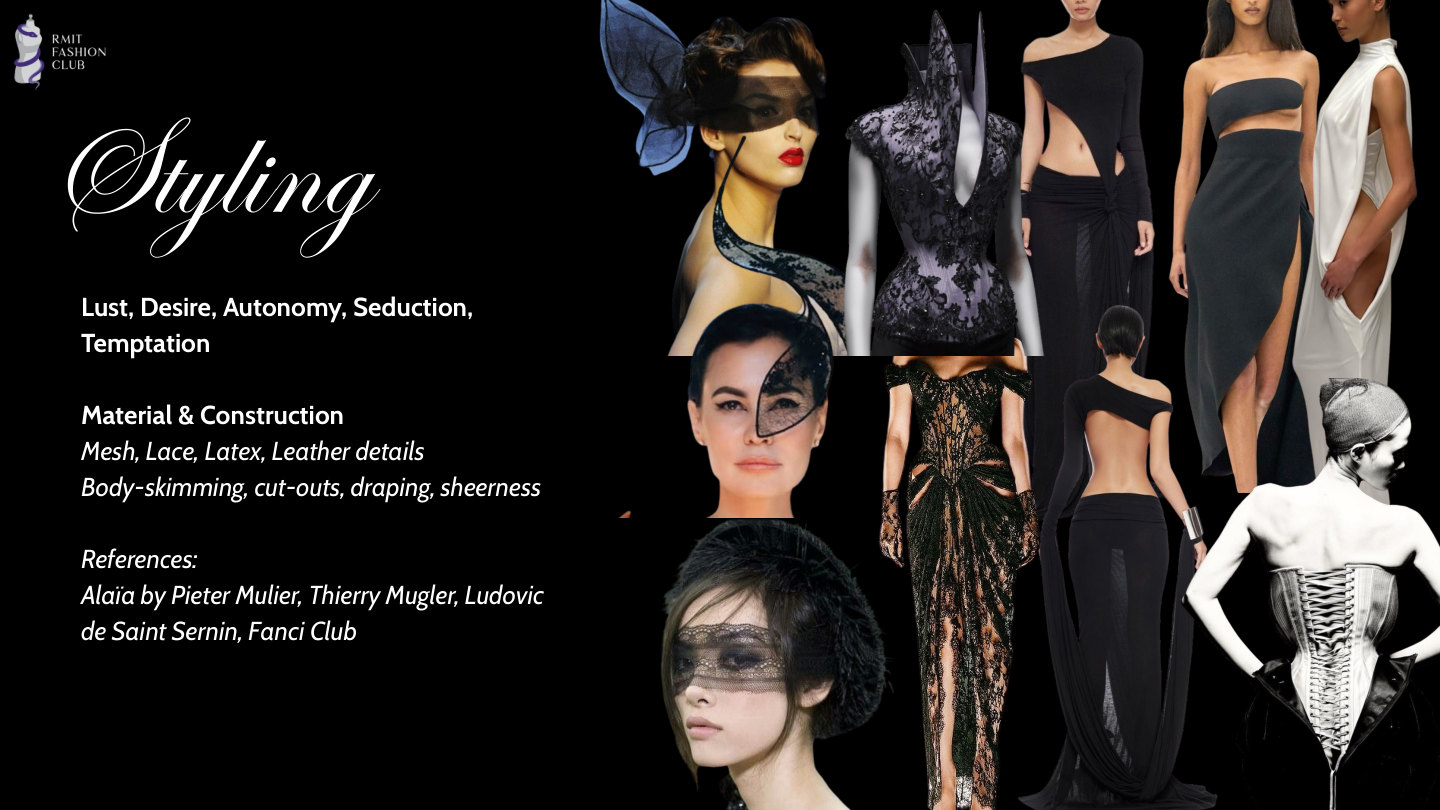
Serpent

Desire

Desire as condemnation

The Serpent shows the double standard around female sexuality: desired when it pleases others, condemned when a woman claims it for herself. Confidence and sexual freedom can quickly be turned into shame, threat or blame.

Keywords
Lust, desire, autonomy, seduction, temptation.
Elements
Lace and lacing.
Materials
Mesh, lace, latex and leather details.
Construction
Body-skimming shapes, cut-outs, draping and sheerness.
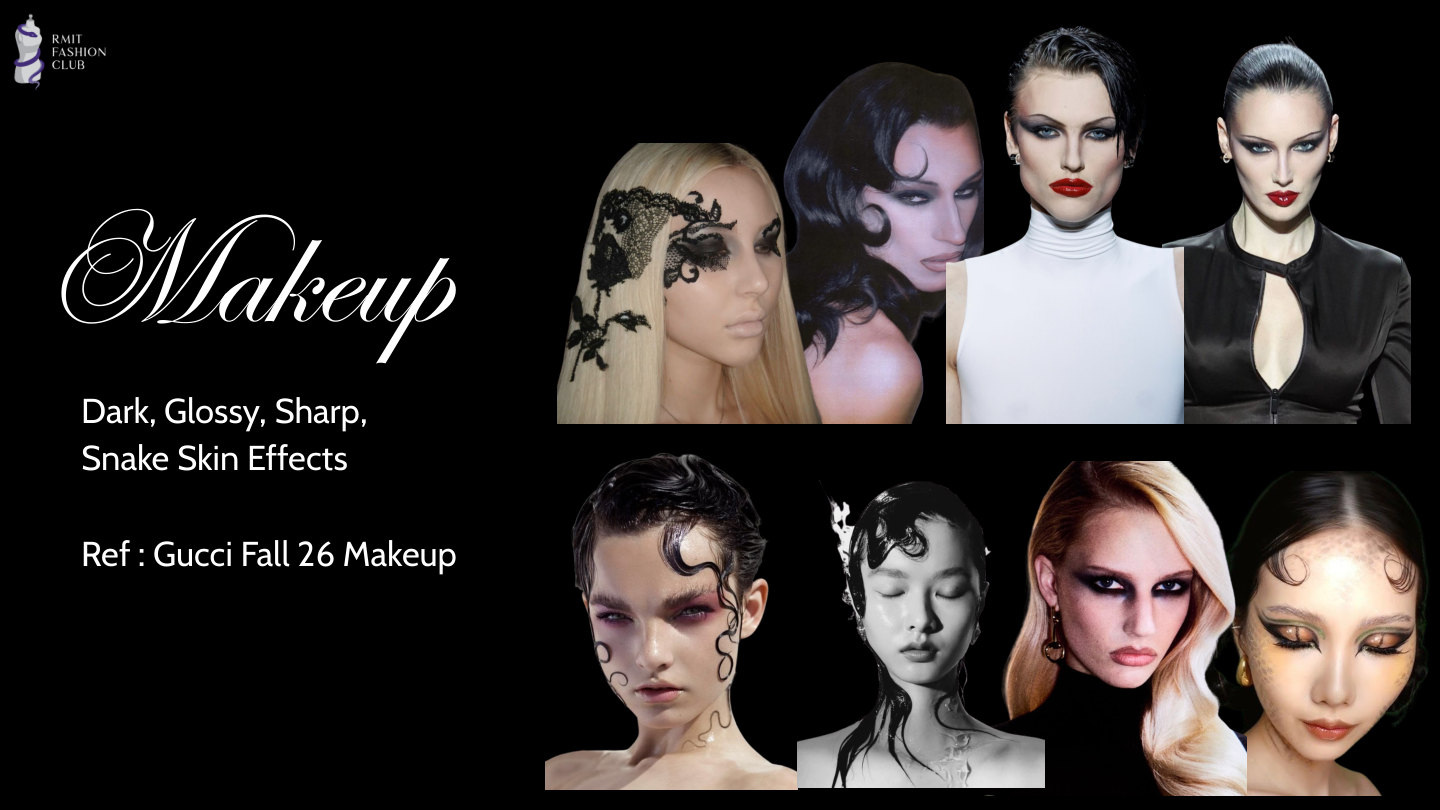
Makeup
Dark, glossy and sharp, with snake-skin effects.
Named references
Alaïa by Pieter Mulier; Thierry Mugler; Ludovic de Saint Sernin; Fanci Club; Gucci Fall 2026 makeup.
In the film

Phase 6, 25 seconds. To be desired.

Treatment p. 43, p. 44, p. 45, p. 46
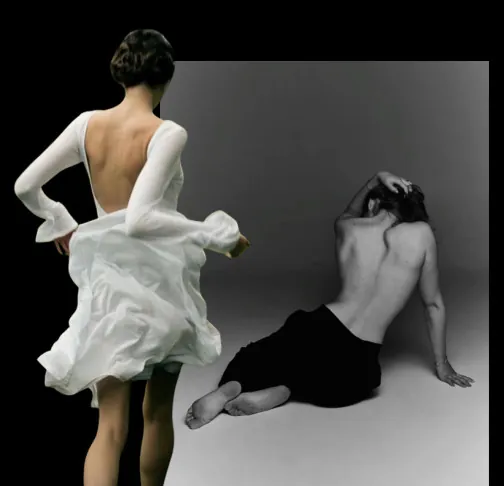
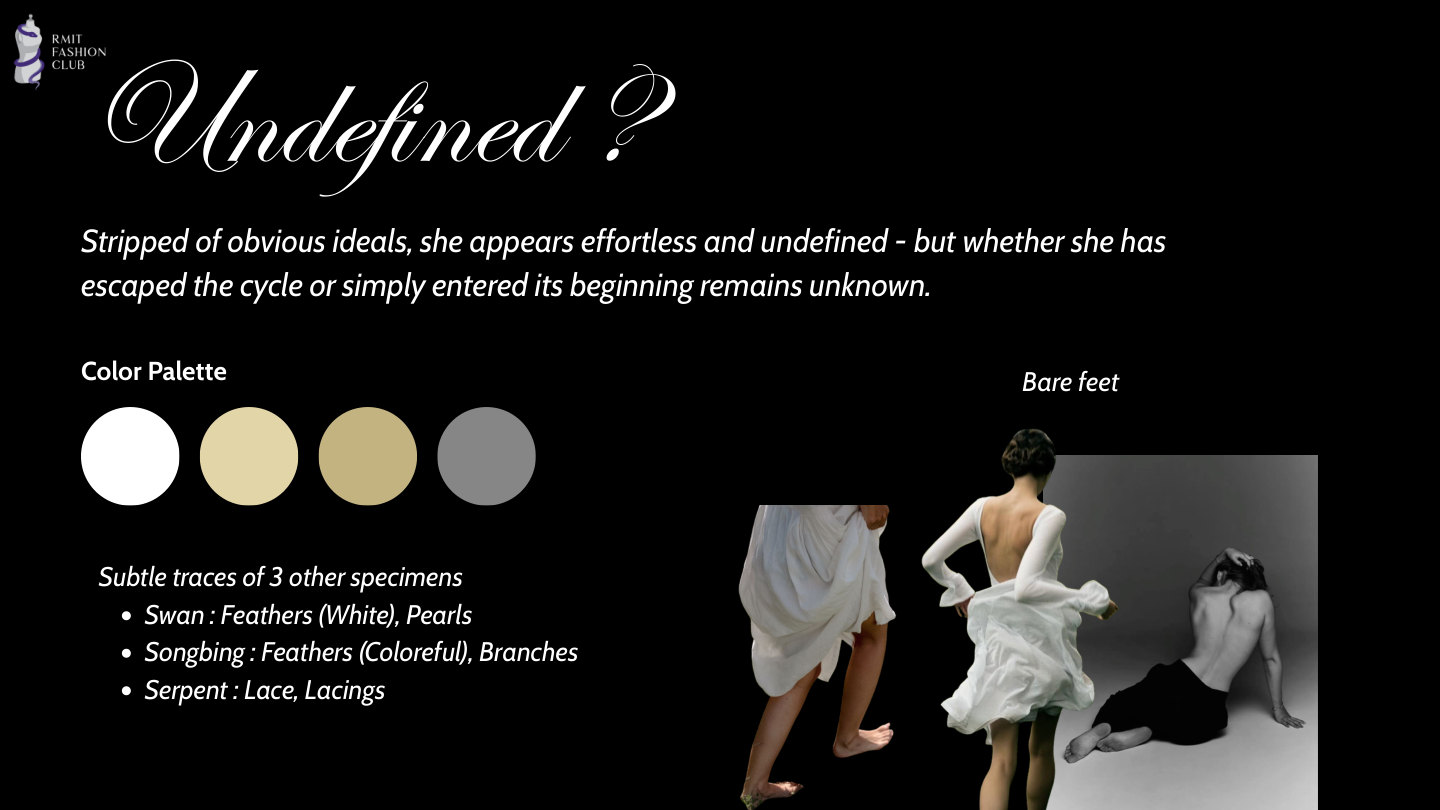
Specimen 04 reference images from the treatment
Reference images from the treatment. Work by other artists, not Menagerie footage.

Specimen 04

Undefined

Undefined, and still being defined

Without any obvious ideal, she looks effortless and undefined. Whether she has escaped the cycle or only reached its beginning stays unknown.

Keywords
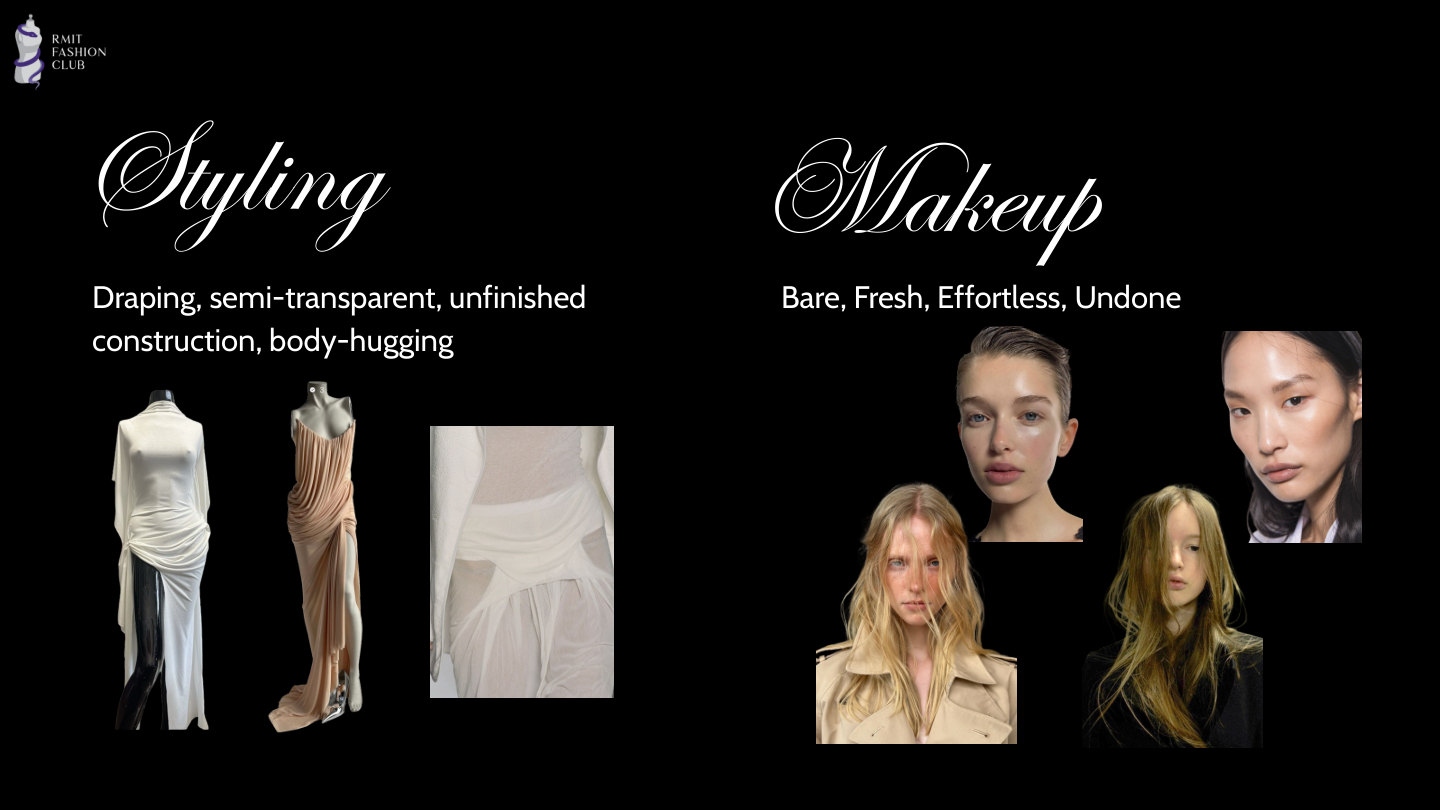
Bare, fresh, effortless, undone.
Elements
Bare feet, with small traces of the other three: white feathers and pearls from the Swan, coloured feathers and branches from the Songbird, lace and lacing from the Serpent.
Materials
The treatment names the styling but not specific fabrics.
Construction
Draping, semi-transparent, unfinished construction, close to the body.
Makeup
Bare, fresh, effortless and undone.
Named references
The pages show visual references without naming their makers.
In the film

In every phase. The whole film follows her.

Treatment p. 47, p. 48

06 Audience

Who the film is for

From the treatment’s audience pages.

  1. Primary audience

    Who

    RMIT students and international students aged 18 to 25, of any gender, who care about how femininity is shaped. Young people who follow fashion, film and art: students, designers, stylists, models and media crews. Anyone who feels pressure to look perfect because of social media and beauty trends.

    Why it matters to them

    They love fashion and beauty but feel judged, compared and never good enough. They want stories that question beauty standards honestly, and they like dark, symbolic films they can talk about afterwards.

  2. Secondary audience

    Who

    Young cinephiles aged 18 to 30: film students, emerging creatives and independent filmmakers who go to arthouse screenings, festivals, film clubs and online film groups.

    Why it matters to them

    They look for experimental and psychological films with unusual storytelling, visual symbols and open endings that invite their own reading.

Treatment p. 26, p. 27

07 Production

Making the film

The plan as of 28 October. Dates come from the team timelines.

  1. 01

    Two places

    Panorama Studio, 42A Tôn Thất Thuyết, for the dream: the Swan, Songbird and Serpent sets. Umi's house for waking life and the false awakening.

  2. 02

    Shoot days

    Monday 16 November at Panorama: the Swan, Songbird and Serpent in one 15-hour day. Monday 23 November at Umi's house: Reality and the false awakening. The photoshoot follows on 24 and 25 November.

  3. 03

    Before the shoot

    The media team's breakdown of the treatment is due Thursday 29 October, and its final version Saturday 31 October. The film scout is on 3 and 4 November. The media team's fourth proposal, with the gear list and lighting maps, is due Thursday 5 November. The PMs give feedback on 6 November, and the final version is due Saturday 7 November.

  4. 04

    Rehearsals

    Dry run on Tuesday 10 November. On Thursday 12 November the team works through the fix list from the dry runs and holds an acting workshop with a makeup test and fitting. Wet run on Friday 13 November, after dark in Vy Anh's garden. Neither rehearsal uses rented gear.

  5. 05

    The voice

    A recorded male narration guides her through the film. Who records it, and whether it plays on set, is still open.

  6. 06

    Post-production

    The media team's first draft of the film is due Monday 30 November. The media team and the PMs meet to finalise it on Thursday 3 December.

  7. 07

    Delivery

    No date set yet. Planned formats are a 16:9 master at 25 frames a second, an MP4 copy and an exhibition copy, with a short 9:16 cut if the media team wants one.

The on-set days are the official list of 28 October. The other dates come from the PM master timeline (saved 25 October) and the media timeline. The treatment's production pages still plan one shoot day on Wednesday 18 November.

08 Open decisions

Decisions still to make

Questions the treatment does not settle yet.

  1. 01

    The voice

    Who records the male narration, and is it played on set?

    Discuss with Director and sound lead

  2. 02

    The length

    Three minutes or five, and does the phase timing follow 170 or 180 seconds?

    Discuss with Director

  3. 03

    The redress

    What changes between the Swan, Songbird and Serpent sets, so each change can be timed?

    Discuss with Director and art direction

  4. 04

    The dream effects

    Made in camera, or added in the edit?

    Discuss with Director and cinematographer

  5. 05

    The coin

    Version 6 dropped the coin page. Is the spinning coin still the film's last image?

    Discuss with Director

09 Research

Research context

Outside research added by the producer. It gives context, not proof.

Theory

Objectification as a theoretical lens

Objectification theory offers a framework for considering the experiential consequences of a culture that sexually objectifies women's bodies. It gives context for the film's attention to being watched and judged.

A theoretical framework does not validate the film's archetypes or show that every woman's experience follows the same pattern.

Fredrickson & Roberts, 1997
Experiment

Idealized images and short-form video

In an experiment with 211 young women, viewing appearance-ideal images or videos went with lower appearance satisfaction and higher negative mood and self-objectification than appearance-neutral content.

The results concern that sample and those viewing conditions. They do not measure the effect of Menagerie or show that critical fashion films change what viewers believe.

Gurtala & Fardouly, 2023

Neither source studies Menagerie. Summaries are limited to the abstracts.

Sources

Where this page comes from.

Main source

The director’s film treatment, version 6, 63 pages, 6 October 2026. Page numbers on this site refer to that PDF. Production dates follow the team timelines as checked on 28 October, where the treatment is older.

Earlier source

This site first presented the 50-page creative brief of September 2026. The treatment replaces it for the film. The specimen styling text is the same in both.

Research references

  1. Fredrickson, B. L., & Roberts, T.-A. (1997). Objectification Theory: Toward Understanding Women's Lived Experiences and Mental Health Risks. Psychology of Women Quarterly, 21, 173-206. doi.org/10.1111/j.1471-6402.1997.tb00108.x
  2. Gurtala, J. C., & Fardouly, J. (2023). Does medium matter? Investigating the impact of viewing ideal image or short-form video content on young women's body image, mood, and self-objectification. Body Image, 46, 190-201. doi.org/10.1016/j.bodyim.2023.06.005

Images

Images are rendered from the treatment. Most show reference work by other artists, not Menagerie footage. Individual image credits were not supplied.

10 Treatment pages

Treatment pages

Select a page to see it full size. The arrow keys move between pages.

Treatment page 11: Master map: the seven phases
p. 11 Master map: the seven phases
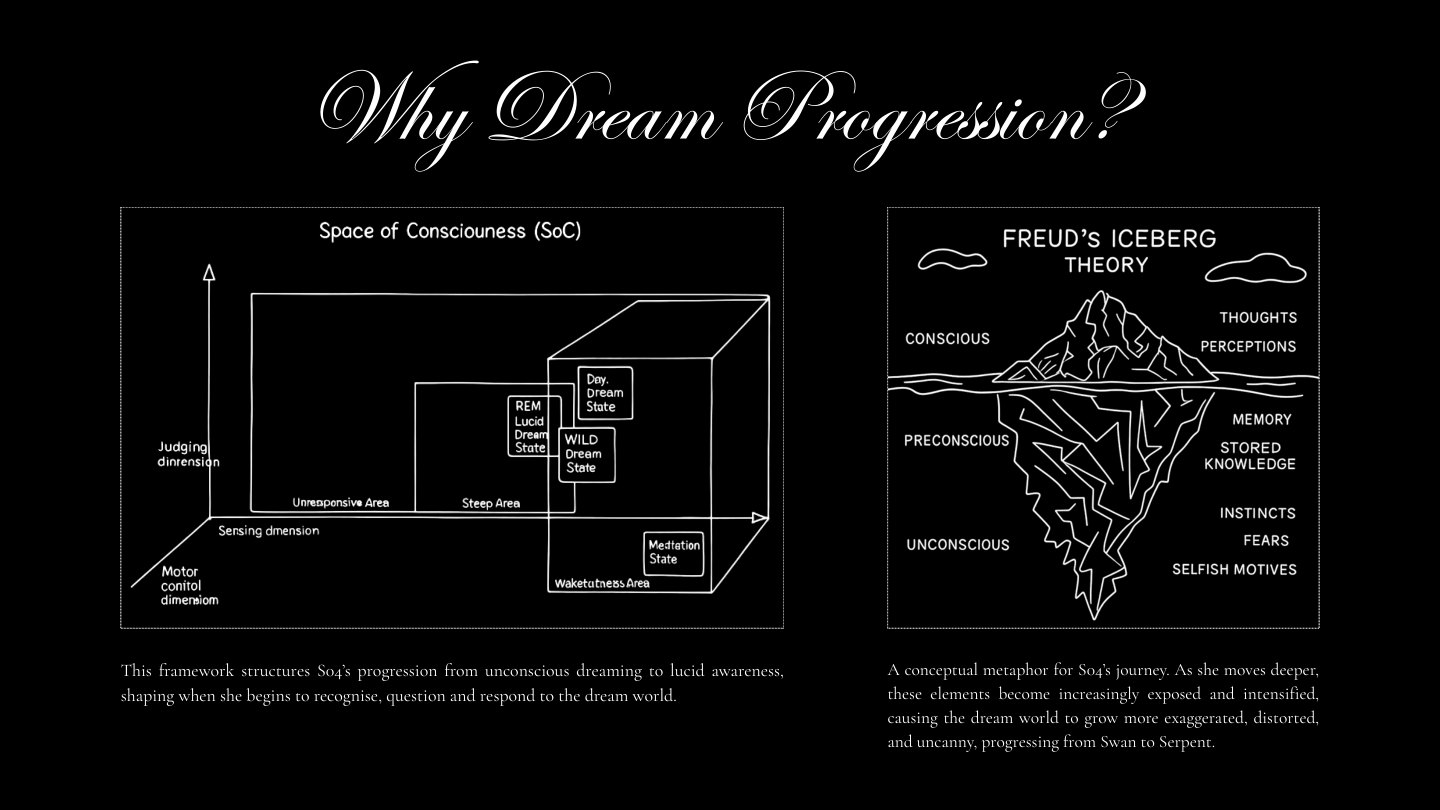
Treatment page 12: Why a dream progression
p. 12 Why a dream progression
Treatment page 14: Moodboard
p. 14 Moodboard
Treatment page 15: Mood and tone
p. 15 Mood and tone
Treatment page 16: Visual style: point of view
p. 16 Visual style: point of view
Treatment page 17: Visual style: the three cages
p. 17 Visual style: the three cages
Treatment page 19: Reality
p. 19 Reality
Treatment page 20: Swan phase
p. 20 Swan phase
Treatment page 21: Songbird phase
p. 21 Songbird phase
Treatment page 22: Serpent phase
p. 22 Serpent phase
Treatment page 35: Swan
p. 35 Swan
Treatment page 37: Swan: styling
p. 37 Swan: styling
Treatment page 38: Swan: makeup
p. 38 Swan: makeup
Treatment page 39: Songbird
p. 39 Songbird
Treatment page 41: Songbird: styling
p. 41 Songbird: styling
Treatment page 42: Songbird: makeup
p. 42 Songbird: makeup
Treatment page 43: Serpent
p. 43 Serpent
Treatment page 45: Serpent: styling
p. 45 Serpent: styling
Treatment page 46: Serpent: makeup
p. 46 Serpent: makeup
Treatment page 47: Specimen 04
p. 47 Specimen 04
Treatment page 48: Specimen 04: styling and makeup
p. 48 Specimen 04: styling and makeup